

Renters Insurance Cost Oregon: What to Expect and How to Save
Renters insurance cost in Oregon varies widely depending on your situation, but most tenants pay between $15 and $30 monthly for basic coverage. Understanding what influences your premium helps you make smarter decisions about protection and savings.
At LeDoux Insurance, we’ve helped countless Oregon renters find affordable policies that actually cover their needs. This guide breaks down real pricing, practical discounts, and coverage options so you can stop guessing and start saving.
Average Renters Insurance Costs in Oregon
Most Oregon renters pay between $15 and $30 monthly for renters insurance, though this figure shifts significantly based on your specific situation. According to the National Association of Insurance Commissioners, the national average for renters insurance sits around $180 annually, which translates to roughly $15 per month. Oregon tracks closely to this national average, making it a relatively affordable state for renters coverage. However, individual premiums can range from $10 monthly for minimal coverage in rural areas to $50 or more in Portland and Eugene where replacement costs run higher and theft claims occur more frequently. Your actual rate depends heavily on the coverage limits you select, your deductible amount, and personal risk factors that insurers weigh during underwriting.
Your Location Matters More Than You Think
Living in Portland versus a smaller Oregon city creates a noticeable price difference. Urban areas like Portland and Eugene experience higher claims rates, which pushes premiums up by 20 to 40 percent compared to rural counties. A renter in Portland might pay $25 to $35 monthly for the same coverage that costs $15 to $20 in rural areas. Building age, local crime statistics, and proximity to fire stations all factor into your rate. Older apartment complexes with outdated electrical systems and lower water pressure ratings generate higher premiums because insurers view them as higher risk. If you live in a newer building with modern safety systems, you qualify for better rates from the start. Water damage claims spike significantly in Oregon due to the climate, and insurers adjust pricing accordingly in high-risk zip codes.
What Actually Drives Your Premium Up or Down
Your claims history is the single most powerful factor controlling your rate. Renters with zero claims over five years typically qualify for the best available pricing. One water damage claim can increase your premium by 15 to 25 percent for three to five years. Your credit score also influences pricing in Oregon-renters with excellent credit scores often pay 10 to 15 percent less than those with poor credit, according to research from the Consumer Federation of America. The amount of personal property coverage you purchase directly affects your monthly cost. Selecting $20,000 in coverage costs noticeably less than choosing $50,000.
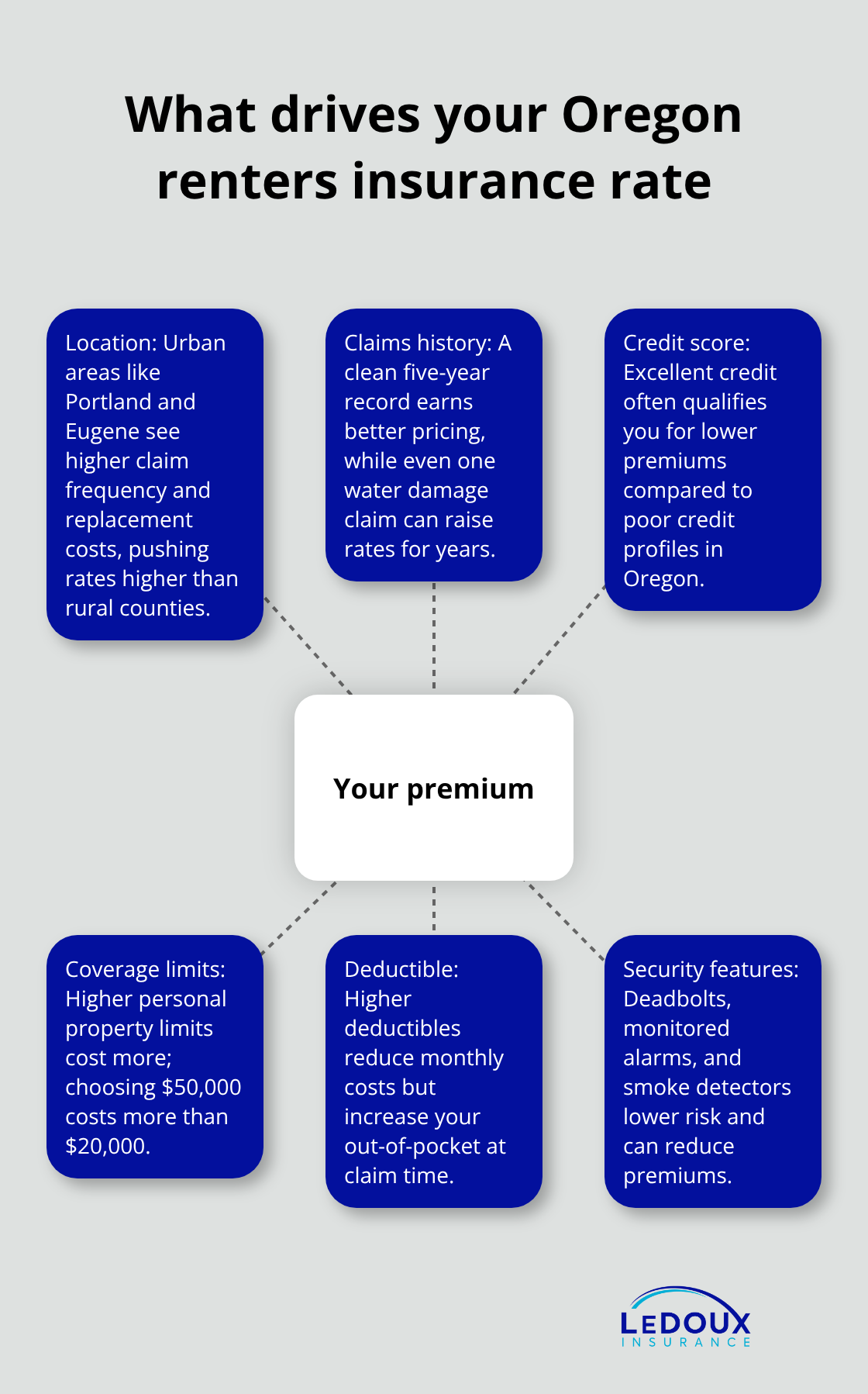
Your deductible choice creates immediate savings opportunities. Jumping from a $250 deductible to a $500 or $1,000 deductible typically reduces your monthly premium by 10 to 20 percent. Security features matter as well. Installing deadbolt locks, security systems, or smoke detectors can lower your rate by 5 to 10 percent because these features reduce claim likelihood.
How to Identify Your Best Rate
The factors that influence your premium interact with each other, which means small changes can add up to meaningful savings. Your insurer weighs your location, claims history, credit score, and security features together when calculating your final rate. Two renters with identical coverage limits can pay vastly different premiums based on these variables. Understanding which factors you can control (deductible, security features, coverage limits) versus which ones you cannot (location, building age) helps you focus your efforts on real savings. The next section explores concrete strategies that lower your costs without sacrificing the protection you need.
Ways to Lower Your Renters Insurance Premiums
Bundle Policies for Maximum Discounts
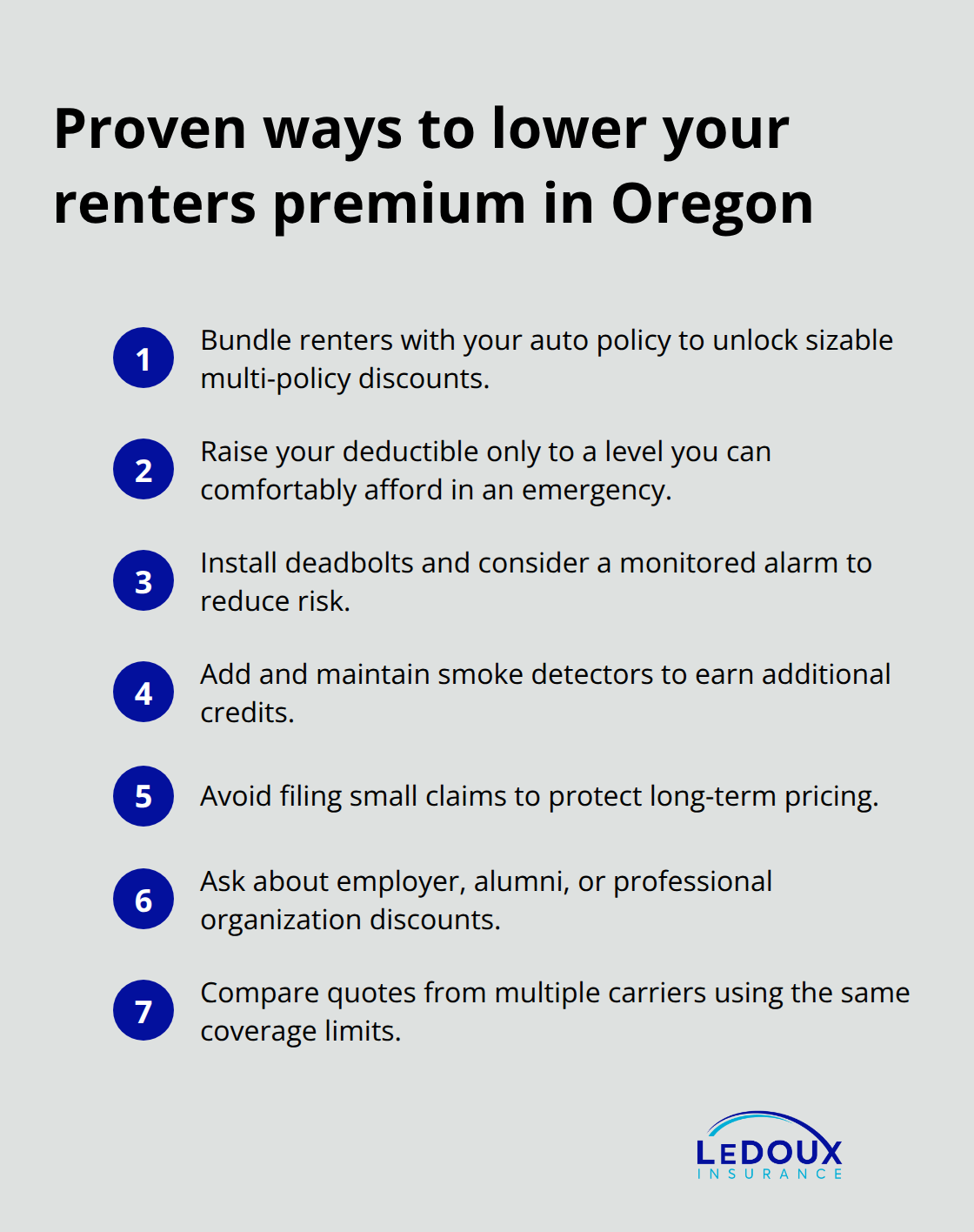
Reducing your renters insurance cost in Oregon doesn’t require sacrificing coverage quality. The most effective strategy is bundling your renters policy with other insurance you already carry. If you have auto insurance, adding renters coverage to the same insurer typically cuts your renters premium by 10 to 25 percent according to the Insurance Information Institute. Most Oregon insurers offer bundling discounts automatically when you consolidate policies, though you need to ask explicitly because they won’t always volunteer the savings.
Increase Your Deductible to Reduce Costs
Raising your deductible from $250 to $500 cuts your monthly premium by roughly 10 to 15 percent, and jumping to a $1,000 deductible can reduce costs by 15 to 20 percent. This strategy only works if you can actually afford to pay that deductible out of pocket when you file a claim-otherwise you create financial stress rather than savings. The math matters here: calculate whether the premium reduction over several years exceeds what you’d pay if you filed one claim at the higher deductible. Learning deductible tips can help you make this decision with confidence.
Improve Home Security and Safety Features
Security improvements deliver consistent savings because insurers quantify reduced risk directly. Installing deadbolt locks on all exterior doors, adding a monitored security system, or placing smoke detectors in your unit typically generates 5 to 10 percent premium reductions. Some insurers offer larger discounts for professionally monitored systems, sometimes reaching 15 percent, though the system cost itself usually offsets savings in year one.
Maintain a Clean Claims History
Your claims history is the factor you control most powerfully over time. Renters who avoid filing claims for five straight years qualify for loyalty discounts ranging from 10 to 20 percent with most carriers. Even small claims damage your rate significantly-filing one water damage claim can increase your premium by 15 to 25 percent for three to five years. This means handling minor damage out of pocket often makes financial sense when the repair cost falls below your deductible plus the premium increase you’ll face.
Activate Employer and Organization Discounts
Contact your current insurer about available discounts you haven’t activated yet. Many renters miss employer-sponsored discounts, alumni association discounts, or professional organization discounts that range from 5 to 15 percent. Oregon renters who work in education, healthcare, or government positions frequently qualify for additional discounts their employers negotiate with major carriers. Once you’ve maximized these discount opportunities, request a quote to see your actual savings.
Coverage Options and What They Cost
Understanding Your Core Protection Categories
Renters insurance coverage splits into distinct categories, and understanding what each one costs helps you build a policy that matches your actual situation rather than overpaying for protection you don’t need. Liability protection covers injuries or property damage you cause to someone else, and it typically starts at $100,000 in coverage for around $1 to $3 monthly added cost. Medical payments coverage pays for injuries visitors sustain in your rental unit, regardless of fault, and usually costs $1 to $2 monthly for $1,000 to $5,000 in coverage.
Personal Property Coverage: Where Your Premium Concentrates
Personal property coverage is where your premium dollars concentrate because it protects your belongings against theft, fire, and other covered perils. Selecting $20,000 in personal property coverage costs significantly less than $40,000, and most Oregon renters need somewhere between $25,000 and $35,000 based on their possessions. Renters typically underestimate their belongings value by 30 to 50 percent, which means you should photograph your items and add up replacement costs rather than guessing.
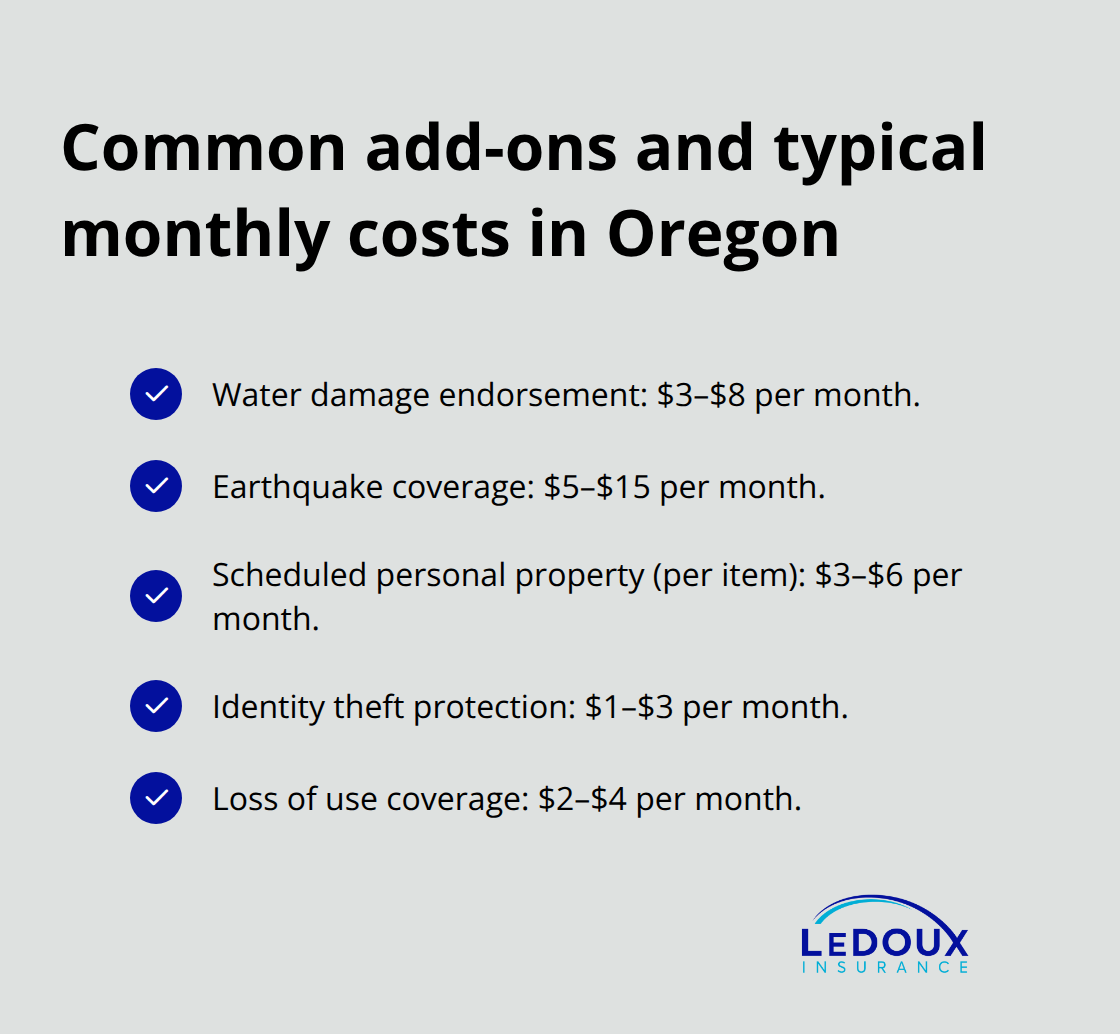
Water damage from burst pipes or leaks is Oregon’s most common renter claim due to our climate, and you need to confirm whether your policy covers this peril because many basic plans exclude it or require an additional endorsement costing $3 to $8 monthly.
Specialized Riders for High-Value Items and Regional Risks
Additional coverage riders address specific gaps that standard policies leave exposed. Earthquake coverage costs $5 to $15 monthly in Oregon depending on your location and building construction, and given that Oregon sits on the Cascadia Subduction Zone, this protection warrants serious consideration rather than dismissal. Valuable items like jewelry, cameras, or musical instruments have coverage limits of $250 to $500 on standard policies, so insuring a $2,000 engagement ring or $3,000 camera requires a scheduled personal property rider costing $3 to $6 monthly per item.
Identity theft protection and credit monitoring riders have become standard add-ons costing $1 to $3 monthly, and they’re worth including given how frequently data breaches expose renter information. Loss of use coverage pays for temporary housing if your rental becomes uninhabitable due to a covered loss, and it typically costs $2 to $4 monthly for $10,000 to $15,000 in protection.
Matching Coverage to Your Actual Needs
The most practical approach involves starting with the coverage amounts that match your actual needs rather than selecting arbitrary limits, then adding riders for specific high-value items or regional risks like earthquakes. Comparing quotes across carriers reveals dramatic price differences for identical coverage combinations, so requesting quotes with your exact coverage selections specified produces meaningful savings rather than settling for whatever default package an insurer offers.
Final Thoughts
Oregon renters insurance costs between $15 and $30 monthly for most tenants, but your actual rate depends entirely on the choices you make and the coverage you select. The strategies covered throughout this guide-bundling policies, raising your deductible, improving security features, and maintaining a clean claims history-deliver real savings without forcing you to compromise on protection. Start by calculating your personal property value accurately, then request quotes with your exact coverage needs specified rather than accepting default package options.
Comparing quotes across multiple carriers reveals price differences of 30 to 50 percent for identical coverage, which means shopping around produces tangible results. Finding affordable renters insurance cost in Oregon requires more than just picking the cheapest option available. You need a partner who understands Oregon’s specific risks, knows which carriers offer the best rates for your situation, and can explain coverage options in plain language.
Contact LeDoux Insurance to discuss your renters insurance needs with a local agent who understands Oregon’s climate challenges, local crime patterns, and building characteristics. We’ll walk you through coverage options, identify discounts you qualify for, and build a policy that actually fits your situation instead of leaving you underprotected or overpaying for unnecessary coverage.
The information provided in this blog is for general informational purposes only and does not constitute legal, financial, or insurance advice. Coverage options, terms, and availability may vary. Please consult with a licensed professional for advice specific to your situation. Artificial intelligence may have been used to generate text and images in some blog articles.

