

Rental Car Insurance Oregon: What You Need to Know Before You Travel
Renting a car in Oregon means navigating insurance decisions that directly affect your wallet and peace of mind. Many travelers assume their personal auto policy or credit card covers everything-but gaps often exist that leave you exposed.
We at LeDoux Insurance want you to travel with confidence. This guide walks you through rental car insurance options, what Oregon requires, and how to pick the right coverage for your trip.
What Rental Car Insurance Actually Covers
Understanding the Basics
Rental car insurance in Oregon protects you against financial loss if your rented vehicle gets damaged, stolen, or causes injury to others. The coverage works differently than your personal auto policy, and that distinction matters when you sign paperwork at the rental counter. Collision coverage pays for damage to the rental car from accidents, while comprehensive coverage handles theft, weather, and vandalism.
Oregon’s Liability Requirements
Liability coverage protects you if you injure someone or damage their property. Oregon requires a minimum of $25,000 per person and $50,000 per accident. Loss of use coverage reimburses the rental company’s lost revenue while the car sits in repair.
Why Your Personal Policy May Not Be Enough
Many travelers skip rental insurance thinking their personal policy covers everything, but that assumption costs people thousands in out-of-pocket expenses annually. Your personal auto policy typically covers rentals only if you carry collision and comprehensive coverage at home-and even then, your deductible applies. If you have a $1,000 deductible on your personal policy, you pay that full amount for any rental car damage before insurance kicks in.
Credit Card Protection Has Real Limits
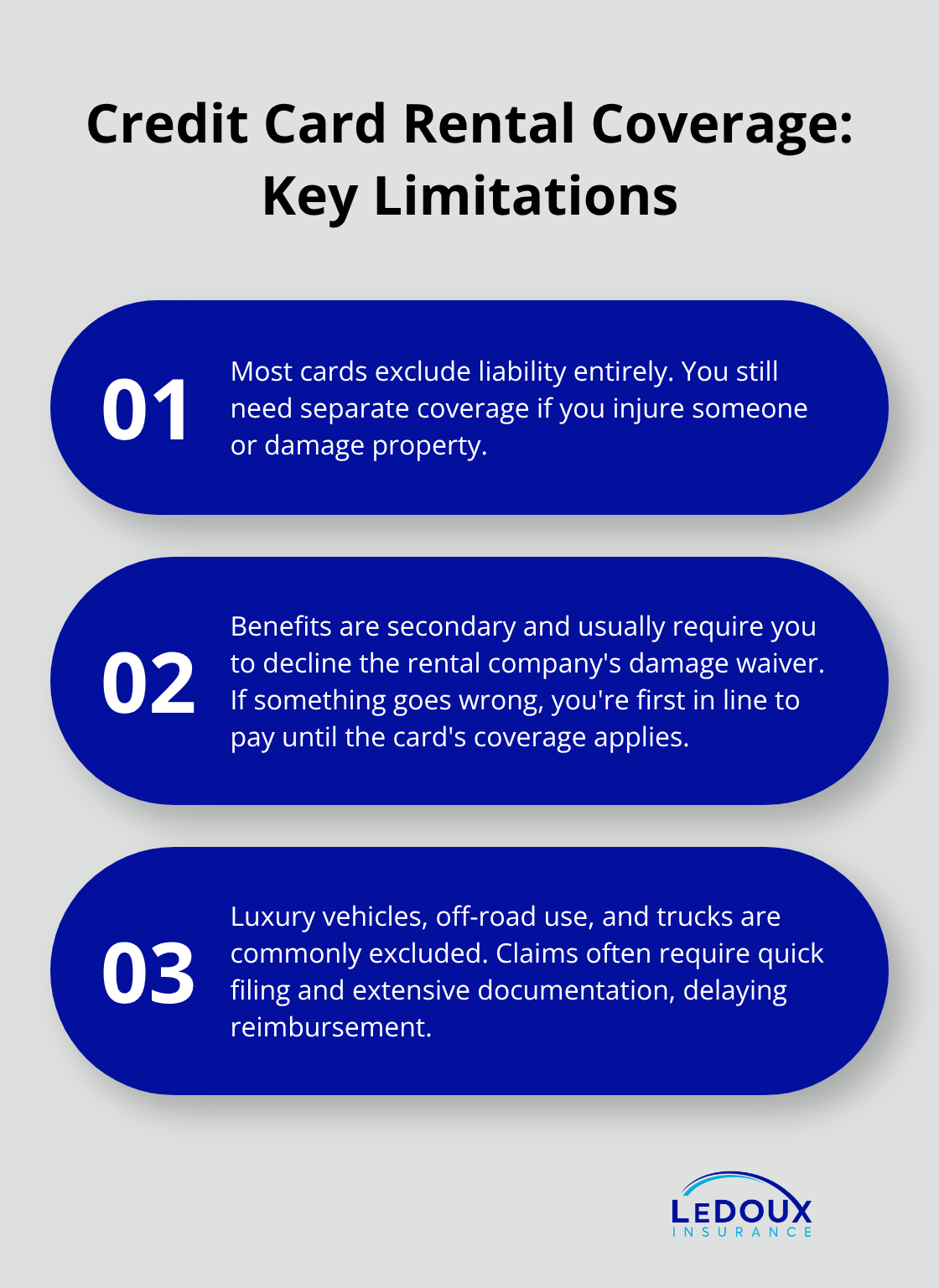
Credit cards often advertise rental car protection, but these secondary policies have massive exclusions. Most credit card programs don’t cover liability, don’t cover damage from driving off-road or on unpaved surfaces, and require you to decline the rental company’s coverage to activate their protection. That means if you accept the rental company’s plan and later file a credit card claim, you face rejection.
The Financial Stakes of Your Decision
Oregon doesn’t impose any special rental car insurance requirements beyond standard liability minimums, so you choose your coverage level. However, choosing poorly leaves you exposed when accidents happen. The rental company holds you financially responsible for any damage, and their damage estimates often exceed $5,000 for moderate collisions based on industry repair data. Your decision at the rental counter determines whether that bill goes to your insurance company or directly to your bank account-which is why understanding your options matters before you arrive at the counter.
Your Four Rental Insurance Pathways
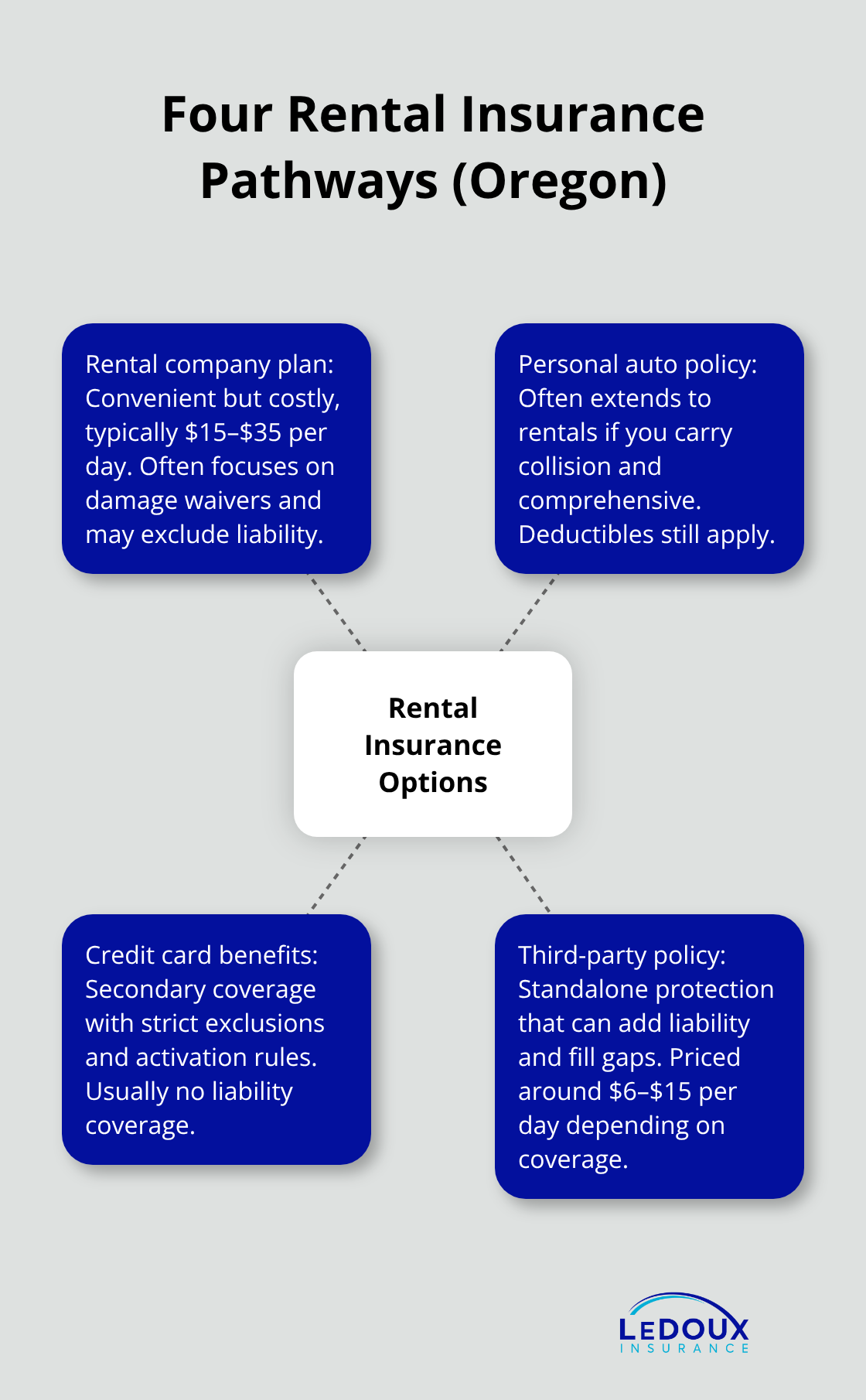
The rental counter offers you four distinct paths forward, and each one works fundamentally differently. The rental company’s coverage plan sits right in front of you, ready to add $15 to $30 daily to your bill. Your personal auto policy may extend to rentals without extra cost, though you won’t know for certain until you check your declaration page. Credit card benefits sound appealing but come loaded with restrictions that catch most travelers off guard. Third-party insurers operate independently, covering gaps that other options miss. Understanding how each pathway functions before you travel matters, because your choice determines whether you absorb thousands in damage costs or your insurance handles it.
Rental Company Plans Cost More Than You Think
The rental company’s daily coverage option feels convenient but operates as an expensive safety net. When you accept their damage waiver, you typically pay between $15 and $35 per day depending on the vehicle class, which adds $150 to $350 to a two-week rental. This plan covers collision and comprehensive damage, but excludes liability coverage in most states-you still need your own liability protection. The rental company’s damage estimates run high because they use OEM parts and dealership labor rates rather than aftermarket alternatives. A moderate fender-bender that would cost $800 at an independent shop often gets quoted at $1,200 to $1,500 through rental company estimates. Once you accept their coverage, you lose negotiating power and can’t dispute their damage assessment without legal intervention. The rental company profits significantly from these daily premiums, which is why they aggressively promote them at the counter.
Personal Auto Insurance Often Covers Rentals at No Extra Cost
Your existing auto policy likely extends to short-term rentals if you carry collision and comprehensive coverage, which means you get protection without daily fees. This approach saves money on a two-week trip-potentially $200 to $400 compared to accepting the rental company’s plan. However, your personal auto policy’s deductible applies, so that $500 or $1,000 deductible you carry at home transfers to the rental vehicle. Before any trip, call your insurance agent and confirm three specific details: whether your policy covers rentals outside your home state, what deductible applies, and whether comprehensive coverage is included. Some policies only cover collision, leaving you exposed if the rental gets stolen or damaged by weather. Out-of-state coverage also has geographic limits for some insurers, so a cross-country trip might fall outside your protection. Your agent can provide written confirmation, which you should bring to the rental counter as proof of coverage.
Credit Card Protection Requires You to Refuse Rental Coverage
Credit card rental benefits sound comprehensive until you read the fine print and discover the exclusions that nullify most claims. The card issuer typically requires you to decline the rental company’s damage waiver to activate their secondary coverage, meaning you must accept financial responsibility if something goes wrong. Their protection usually excludes liability coverage entirely, leaving you exposed if you injure someone or damage another vehicle. Luxury vehicles, sports cars, and trucks often fall outside credit card coverage limits, so your high-end rental sits unprotected. Off-road driving, unpaved surfaces, and commercial use void their protection, which catches renters who venture beyond standard highways. Most credit card companies also require you to file a claim within 90 days and provide extensive documentation, and disputes with card issuers take weeks or months to resolve while the rental company pursues you for payment. If you rely solely on credit card protection and the claim gets denied, you’ve rejected the rental company’s coverage with nothing to fall back on.
Third-Party Insurers Fill the Gaps Others Leave Open
Independent insurance companies specializing in rental coverage operate differently from the rental counter or your personal policy. These providers offer standalone policies that activate regardless of whether you accept the rental company’s plan, giving you layered protection. They typically charge $6 to $15 per day depending on coverage level, significantly less than rental company daily fees. Third-party insurers cover liability in most cases, addressing the gap that credit cards leave open. If your personal auto policy has a high deductible or excludes out-of-state rentals, a third-party policy fills those specific holes without duplicating coverage you already have. Your next step involves assessing your existing coverage and comparing these four pathways to identify which combination protects you best without overpaying for redundant protection.
What to Check Before You Book
Review Your Personal Auto Policy First
Start your rental insurance decision three weeks before your trip by reviewing your personal auto policy’s declaration page, not by accepting whatever the rental counter offers. Call your insurance agent and ask four specific questions: does your policy cover out-of-state rentals, what deductible applies to rental vehicles, does your comprehensive coverage extend to rentals, and will your agent provide written confirmation you can show the rental company. This phone call takes fifteen minutes and prevents thousands in unexpected costs. If your agent confirms full coverage with a reasonable deductible, you’ve likely solved your insurance problem without spending extra money.
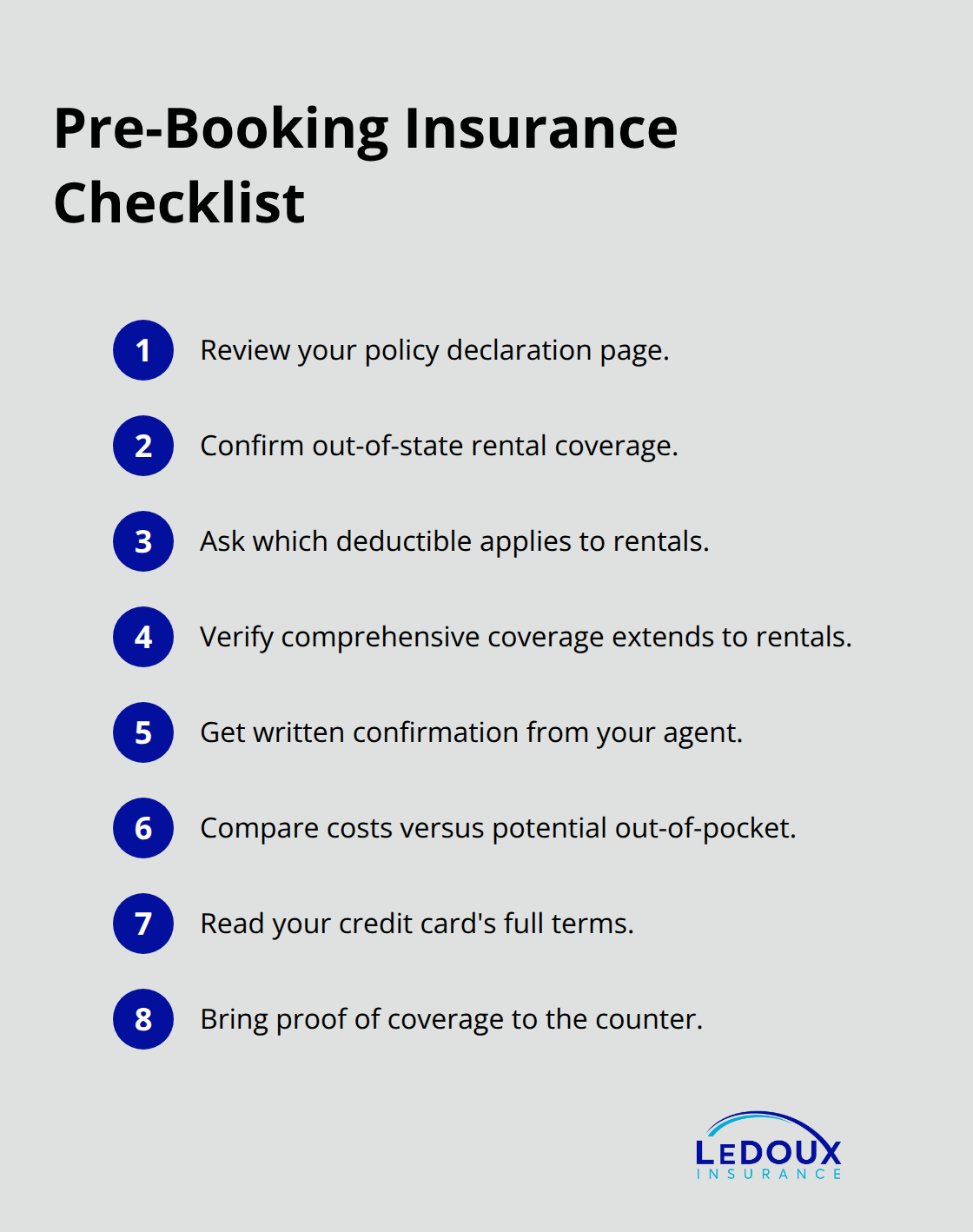
If your policy has gaps-such as excluding out-of-state rentals or carrying a $1,000 deductible you’d rather not pay-you now know exactly what a third-party policy needs to cover. Request written confirmation from your agent, which you should bring to the rental counter as proof of coverage.
Examine Your Credit Card Benefits Carefully
Check your credit card benefits if you plan to use one for the rental payment, but treat this as a last resort rather than your primary protection. Log into your card’s website and find the rental car coverage section, then download or print the full terms document, not just the summary. Credit card companies bury exclusions in dense fine print, and most travelers discover coverage limits only after damage occurs.
Note which vehicle classes the card excludes, what geographic restrictions apply, and whether liability coverage is included. If your card excludes luxury vehicles and you’re renting an upscale sedan, that card protection vanishes the moment you sign the rental agreement.
Calculate Your Financial Exposure
Compare the actual financial scenarios you might face rather than comparing policies in abstract terms. If your personal auto insurance covers the rental with a $500 deductible, calculate whether you’d rather pay $500 out-of-pocket in case of damage or pay $12 per day for a third-party policy on a two-week rental-that’s $168 total. For most travelers, accepting the personal policy’s deductible makes financial sense.
However, if you’re renting a luxury vehicle worth $60,000 and your personal policy carries a $1,000 deductible, a third-party policy at $15 per day costs $210 for two weeks and protects you from that $1,000 exposure if something goes wrong.
Document the Vehicle Condition With Photos
Photograph every panel, window, tire, and interior surface before leaving the lot, then compare your photos against the rental company’s damage checklist. Take photos of the odometer, fuel gauge, and any existing damage they note, and request they email you the damage report immediately. This documentation protects you if the rental company later claims pre-existing damage was your responsibility.
When you return the vehicle, repeat the photography process and request a final inspection report showing no new damage. Most rental damage disputes arise because the renter’s memory differs from the company’s assessment weeks later, and photos eliminate that uncertainty entirely.
Final Thoughts
Rental car insurance in Oregon decisions matter because they determine whether accidents cost you thousands out-of-pocket or whether your coverage handles it. Call your insurance agent and request written confirmation of what your personal policy covers for out-of-state rentals, then review your credit card benefits if you plan to use one (paying special attention to exclusions and geographic limits). Calculate whether accepting your personal policy’s deductible makes financial sense or whether a third-party policy fills gaps more cost-effectively for your trip.
Document the rental vehicle’s condition with photos before you leave the lot and again when you return it, since this single action prevents most damage disputes and protects you from false claims about pre-existing damage. You now have the information to make rental car insurance decisions confidently rather than reactively at the counter. Contact LeDoux Insurance to discuss your rental car insurance needs and get personalized guidance for your Oregon travel plans.
The information provided in this blog is for general informational purposes only and does not constitute legal, financial, or insurance advice. Coverage options, terms, and availability may vary. Please consult with a licensed professional for advice specific to your situation. Artificial intelligence may have been used to generate text and images in some blog articles.

