

Vacation Rental Insurance Oregon: Short-Term Property Protection
Oregon’s vacation rental market has exploded over the past decade, with thousands of property owners generating income from short-term guests. Standard homeowners insurance won’t cover these rentals, leaving you exposed to significant financial risk.
At LeDoux Insurance, we’ve seen firsthand how quickly liability claims and property damage can devastate unprepared owners. This guide walks you through vacation rental insurance in Oregon and how to protect what you’ve built.
Why Vacation Rental Insurance Matters in Oregon
Oregon’s short-term rental market has grown substantially, with platforms like Airbnb and VRBO listing over 15,000 properties statewide as of 2024. This growth reflects real demand from travelers and real income potential for property owners. However, most owners operating these rentals don’t realize their standard homeowners policy explicitly excludes income from short-term guests. Your insurer will deny claims related to rental activities, leaving you personally liable for injuries, property damage, or theft involving guests.
Standard Policies Leave You Exposed
A typical homeowners policy covers your property when you live in it full-time, not when strangers occupy it for days or weeks. Insurance companies classify short-term rentals as commercial activity, and most homeowners policies contain explicit exclusions for rental properties. If a guest falls down your stairs and files a lawsuit, your homeowners insurer will likely deny coverage because you operated a rental. This isn’t a gray area-it’s a direct violation of your policy terms.
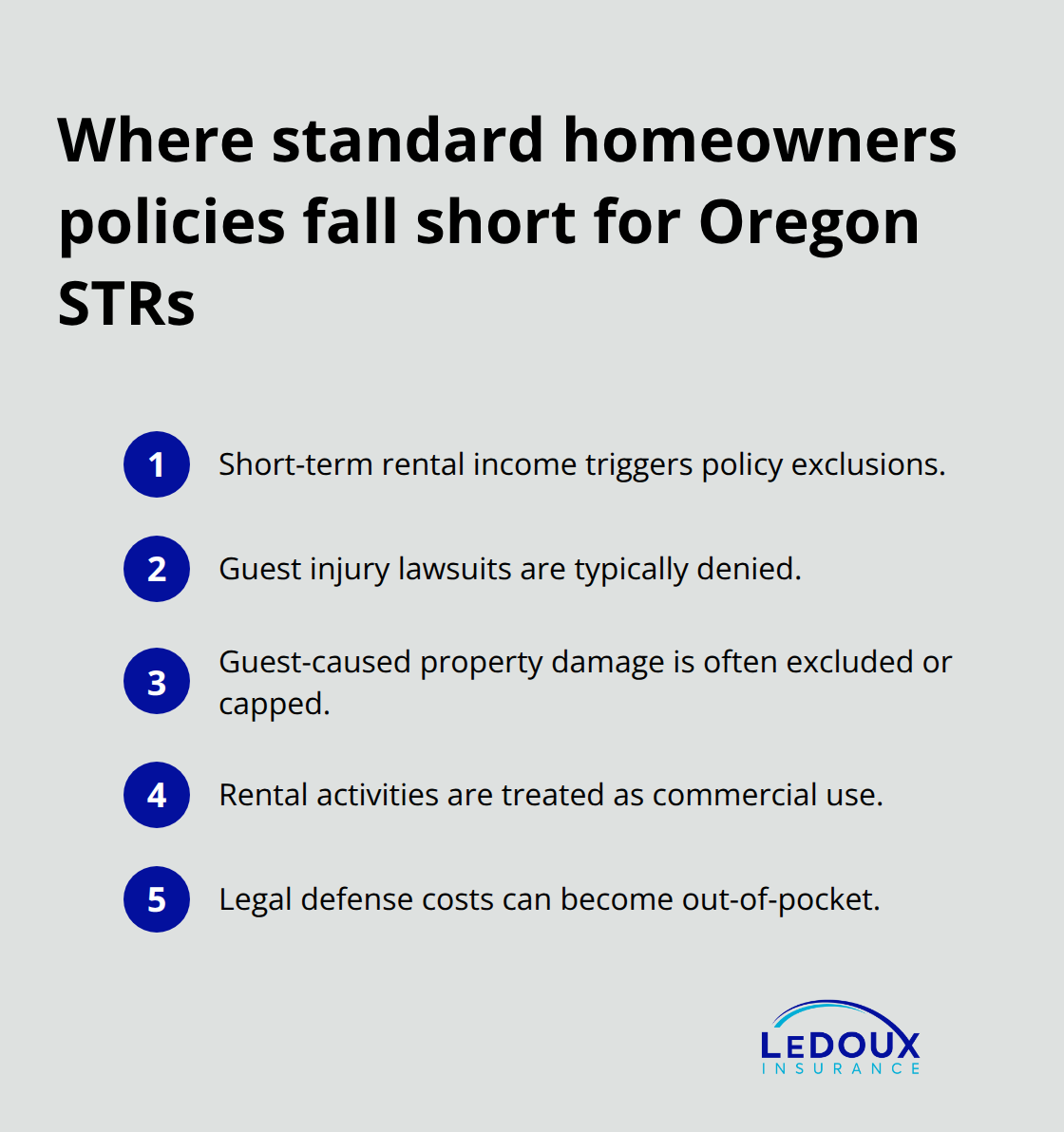
Oregon property owners operating vacation rentals without proper coverage face potential liability judgments of $100,000 to $500,000 or more, depending on injury severity. Your personal assets, savings, and future income become targets in these lawsuits. The financial consequences extend beyond the initial claim to include legal defense costs, which can reach $50,000 to $100,000 before trial.
Guest Injuries Create Substantial Financial Risk
Short-term rental hosts face liability risks that standard homeowners policies don’t address. Guests slip on wet bathroom floors, fall from balconies, suffer food poisoning from shared kitchens, or claim injuries from poorly maintained hot tubs. Each incident carries the potential for significant medical expenses and legal costs.
Premises liability claims can result in substantial medical expenses. Oregon’s courts have awarded significant judgments against property owners for guest injuries, particularly when negligence is involved. Property damage from guests-broken windows, damaged furniture, or stolen items-also falls outside standard homeowners coverage limits.
Vacation Rental Policies Address These Gaps
Vacation rental-specific policies address the protection gaps directly, covering guest injuries up to your selected limits and property damage from rental activity. These policies recognize the unique risks that short-term rental hosts face and provide coverage that standard homeowners insurance simply won’t offer. Understanding your coverage options becomes the next critical step in protecting your investment.
What Coverage Should Your Vacation Rental Actually Have
Vacation rental-specific policies come in several forms, and selecting the right one depends on your property size, guest volume, and risk tolerance. A host renting out a single bedroom through Airbnb faces different risks than someone operating a five-bedroom house with weekly turnover, and your insurance should reflect that distinction.
Host Protection Policies Match Your Rental Model
Host protection policies specifically cover short-term rental activity where standard homeowners insurance stops. These policies typically cover liability claims from guests, property damage caused by guests, and loss of rental income if your property becomes temporarily uninhabitable. Coverage limits range from $100,000 to $1,000,000 for liability, depending on your property value and guest volume.
Platforms like Airbnb offer limited built-in host protection, but this coverage often includes high deductibles (typically $2,500 to $5,000) and excludes certain claim types, making supplemental policies essential. Oregon hosts with properties valued above $300,000 should carry standalone vacation rental policies rather than relying solely on platform protection. Deductibles on dedicated vacation rental policies typically run $500 to $2,500, significantly lower than platform coverage.
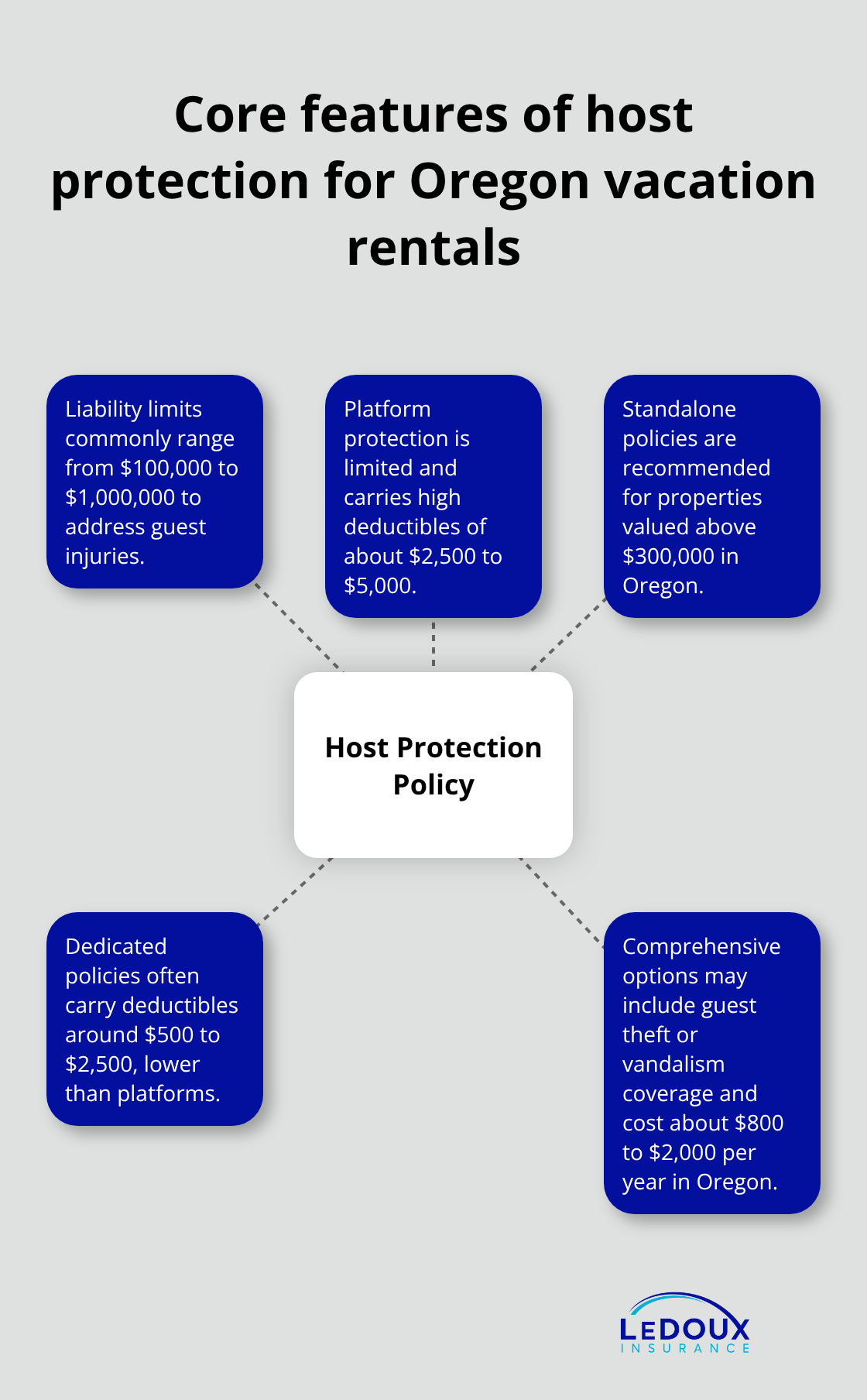
Dedicated policies cover your liability for guest injuries while on your property, including slip-and-fall incidents, hot tub injuries, or accidents in common areas. Some policies include coverage for theft or vandalism by guests, which platform protection often excludes entirely. The annual premium for comprehensive host protection in Oregon typically ranges from $800 to $2,000 depending on property value, location, and claims history.
Property Damage Coverage Protects Against Real Guest-Related Losses
Guest-caused damage represents one of the most frequent claims vacation rental owners file. Broken windows, damaged furniture, stained carpets, and stolen items occur regularly in short-term rental operations. Standard homeowners policies cap or exclude coverage for rental-related property damage, leaving you responsible for repair costs.
A single incident involving broken plumbing fixtures, damaged flooring, or destroyed appliances can easily cost $5,000 to $15,000 out of pocket. Dedicated vacation rental policies include property damage coverage with reasonable deductibles, protecting your investment from guest-caused losses. This coverage applies to structural damage, furnishings, appliances, and personal property you provide for guests.
Some policies also cover loss of rental income if your property becomes uninhabitable following guest-related damage, typically covering 30 to 60 days of lost revenue. Oregon hosts operating in high-turnover markets should try policies with comprehensive property damage limits of at least $50,000 to $100,000. The coverage should explicitly include guest theft, intentional damage, and accidental damage from normal use.
Document your property’s condition with photos and video before each guest arrival, as this documentation supports damage claims and helps insurers process claims faster. This preparation step becomes especially important when you file a claim, since insurers rely on clear evidence of pre-existing conditions versus guest-caused damage. With the right property damage coverage in place, you can focus on your rental operation rather than worrying about unexpected repair bills. Understanding what coverage protects your physical property sets the stage for evaluating how to select the right policy for your specific situation.
Selecting the Right Coverage for Your Rental
Your property’s characteristics determine which coverage limits and policy structure actually make sense for your situation. A one-bedroom cottage in Bend operates differently than a four-bedroom house in Portland’s Pearl District, and your insurance needs reflect that reality. Start by documenting your property value, including the building structure, furnishings, appliances, and outdoor amenities like hot tubs or fire pits. Oregon vacation rental properties range from $200,000 to $2 million in value, and your liability coverage should sit at least 25 to 50 percent above your property’s estimated value. A $500,000 property should carry minimum liability coverage of $250,000 to $500,000, not the $100,000 limits some budget policies offer. Next, count your annual guest nights and average occupancy rate. Properties with fewer than 50 guest nights yearly face lower risk than those with 200-plus guest nights, and insurers price policies accordingly.
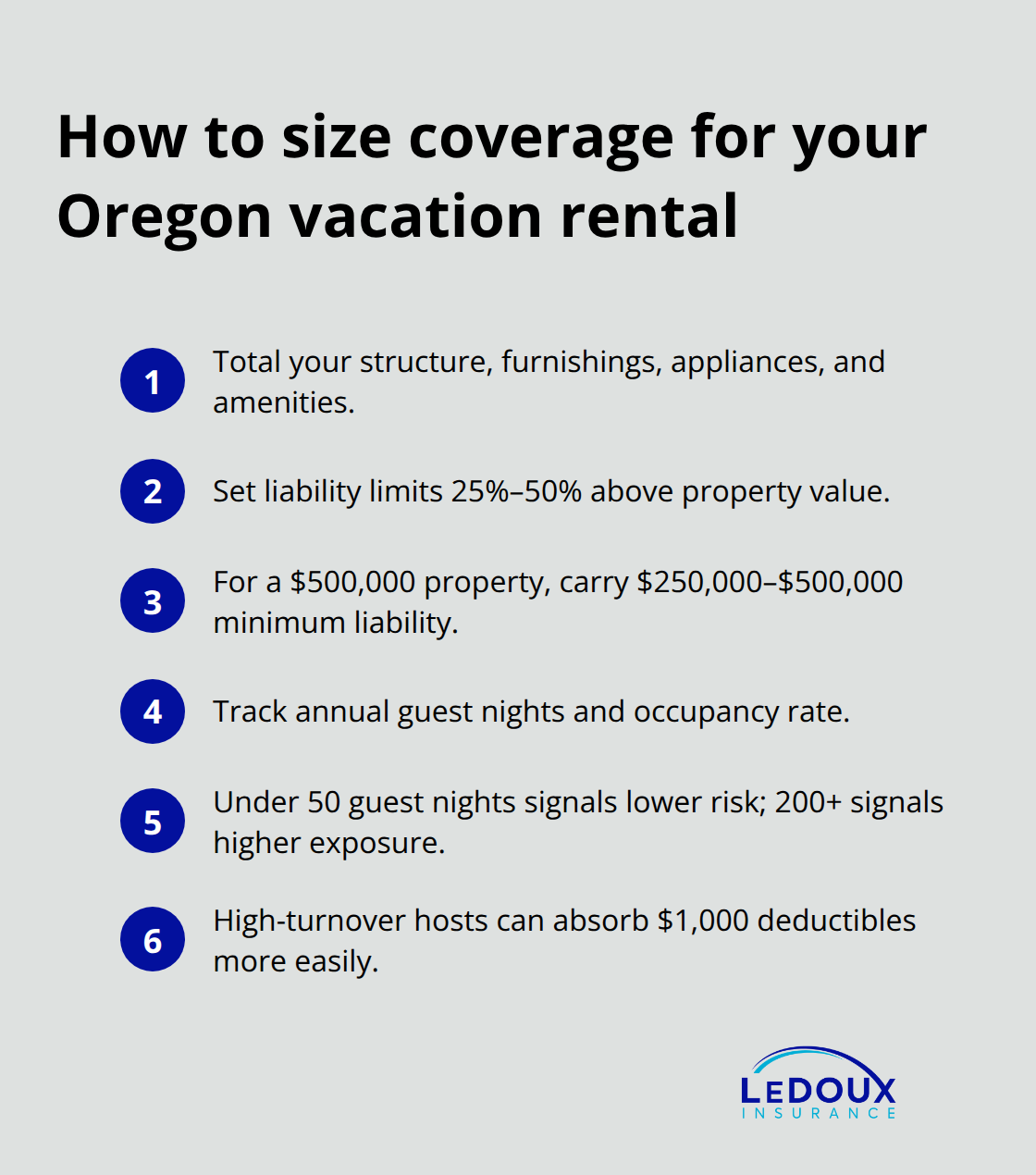
Your guest volume also affects deductible selection-hosts with high turnover can absorb $1,000 deductibles more easily than those renting out only weekends, where a single claim wipes out several months of profit.
Deductibles and Exclusions Determine Your Actual Protection
Comparing deductibles between policies reveals massive differences in your out-of-pocket costs when claims happen. A $500 deductible sounds better than $2,500, but it only matters if the policy covers what you actually need. Read every exclusion carefully, because that’s where insurance companies hide their real limitations. Many vacation rental policies exclude claims involving alcohol-related incidents, parties exceeding a certain guest count, or commercial events like weddings. Some policies won’t cover damage from guests who violated your house rules, which creates a burden on you to document and prove rule violations. Oregon hosts should specifically check whether policies cover liability from hot tubs, pools, or trampolines, since these amenities generate frequent claims. Property damage deductibles sometimes differ from liability deductibles, with some carriers charging $1,000 deductibles for property claims while offering $500 for liability. The cheapest policy rarely provides the best protection-a $600 annual policy with a $2,500 deductible and extensive exclusions costs more than a $1,200 policy with $500 deductibles and comprehensive coverage when claims actually occur. Request sample policies before committing, and have an agent explain every exclusion in plain language rather than accepting marketing materials at face value.
Matching Policy Terms to Your Operating Model
Short-term rental hosts should align their policies with how they actually operate their properties. If you rent through Airbnb and VRBO simultaneously, your policy must cover multi-platform operations rather than limiting coverage to a single booking platform. Some policies include automatic coverage for platform-provided host protection, while others explicitly exclude claims already covered by platform insurance, creating dangerous gaps if platform coverage denies your claim. Document your booking patterns and guest types-corporate travelers, families, or party groups face different risk profiles. Policies specifically designed for corporate housing or longer-term rentals won’t protect you if you operate a party-friendly weekend rental. Oregon hosts operating properties in high-theft areas like downtown Portland should prioritize policies with comprehensive theft coverage rather than policies that exclude theft or cap theft claims at $5,000. Annual policy reviews matter more than most owners realize, since your guest volume, property value, or local risk factors change year to year. Increasing your property’s furnishings or adding amenities like hot tubs requires updated coverage limits. An independent agent can help you review your vacation rental policy every 12 months and discuss changes before renewal, helping your coverage evolve with your operation rather than leaving gaps as your business grows.
Final Thoughts
Vacation rental insurance in Oregon protects your investment when standard homeowners policies leave you exposed. The gap between your current coverage and actual rental risks can cost you tens of thousands of dollars when a guest injury or property damage claim occurs. Oregon’s growing short-term rental market creates more competition for guests, but cutting corners on insurance protection creates financial exposure that outweighs any premium savings.
Your investment in a vacation rental property deserves protection that matches your actual operation. Whether you rent a single bedroom or manage a multi-unit property, selecting the right coverage limits, deductibles, and exclusions determines whether insurance actually protects you when claims happen. Review your current policy’s exclusions carefully, document your property’s condition before each guest arrival, and reassess your coverage annually as your rental business evolves.
The right insurance partner understands Oregon’s vacation rental market and explains your options in straightforward language rather than industry jargon. LeDoux Insurance serves Oregon communities with local agents in Eugene, Salem, Woodburn, and Albany who work with 20+ top-rated carriers to find coverage that fits your specific rental model and budget. Our agents will review your property, discuss your guest volume, and recommend policies that actually protect your investment.
The information provided in this blog is for general informational purposes only and does not constitute legal, financial, or insurance advice. Coverage options, terms, and availability may vary. Please consult with a licensed professional for advice specific to your situation. Artificial intelligence may have been used to generate text and images in some blog articles.

