

Oregon Flood Insurance Options: Protecting Homes From Rising Waters
Flooding poses a serious threat to Oregon homes, yet many homeowners remain unprotected because standard insurance policies exclude water damage. At LeDoux Insurance Agency Inc., we’ve seen firsthand how devastating flood losses can be when families lack proper coverage.
The good news is that Oregon flood insurance options exist to fit different budgets and risk levels. This guide walks you through your choices and helps you find the protection your home needs.
Why Your Oregon Home Needs Flood Insurance
Standard Policies Leave You Completely Unprotected
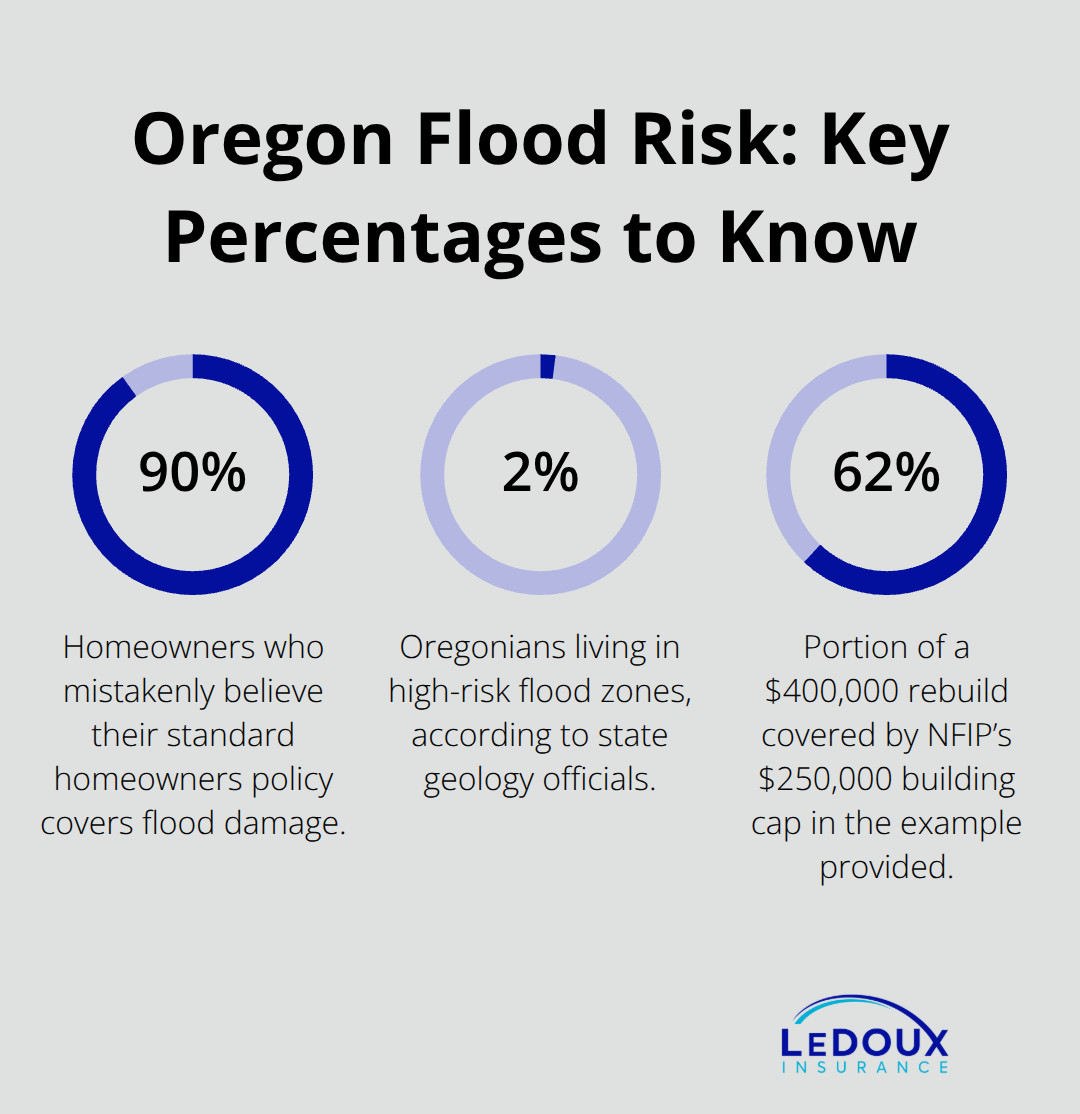
Standard homeowners insurance policies contain a flood exclusion, which means they will not pay for water damage from flooding under any circumstances. The National Association of Insurance Commissioners reports that approximately 90% of homeowners mistakenly believe their standard policy covers flood damage, creating a dangerous protection gap. If a river overflows, heavy rainfall saturates the ground, or a storm surge pushes water into your home, your standard policy leaves you completely exposed.
This isn’t a minor gap either-the average flood claim costs around $35,000 according to FEMA data, and many Oregon properties face significantly higher losses. Without dedicated flood insurance, you pay every dollar of damage yourself, which can mean tens of thousands in out-of-pocket expenses for repairs, replacement of belongings, and temporary housing.
Oregon’s Flood Risk Is Real and Growing
Oregon’s flood risk deserves serious attention because the state experiences flooding regularly across multiple regions. The Willamette Valley, coastal areas, and properties near major rivers face substantial exposure, but urban neighborhoods in Portland, Salem, and Eugene also experience localized flooding during heavy rain events. According to the Oregon Department of Geology and Mineral Industries, approximately 2% of Oregon’s population lives in high-risk flood zones, but an additional 8-10% occupies areas with moderate flood risk. Many homeowners assume they’re safe because they haven’t experienced flooding recently, but climate patterns are shifting-the National Oceanic and Atmospheric Administration has documented increased precipitation intensity in the Pacific Northwest over the past two decades.
Financial Protection Against Catastrophic Loss
Flood insurance protects your financial security against catastrophic loss. Without it, a single flooding event can wipe out years of savings, force you to take on debt, or even lead to foreclosure if your lender requires you to maintain coverage. The right flood insurance policy stands between your family’s financial stability and potential devastation. Understanding your options allows you to select coverage that matches your actual risk and budget, which is exactly what we explore in the next section.
Flood Insurance Options Available to Oregon Residents
The National Flood Insurance Program Remains Your Most Accessible Choice
The National Flood Insurance Program, commonly called NFIP, remains the most widely available option for Oregon homeowners. This federal program has issued over 5 million policies nationwide and covers approximately 1 million properties in high-risk flood zones. NFIP policies are standardized, which means you know exactly what you’re getting regardless of which agent sells you the policy. Premiums depend on your property’s flood zone designation, elevation relative to the base flood elevation, and your home’s construction type.
For a single-family home in a moderate-risk area, NFIP premiums typically range from $400 to $1,200 annually, though properties in high-risk zones pay significantly more. One major limitation of NFIP is the annual payout cap of $250,000 for building coverage and $100,000 for personal property, which falls short of replacement costs for many Oregon homes.
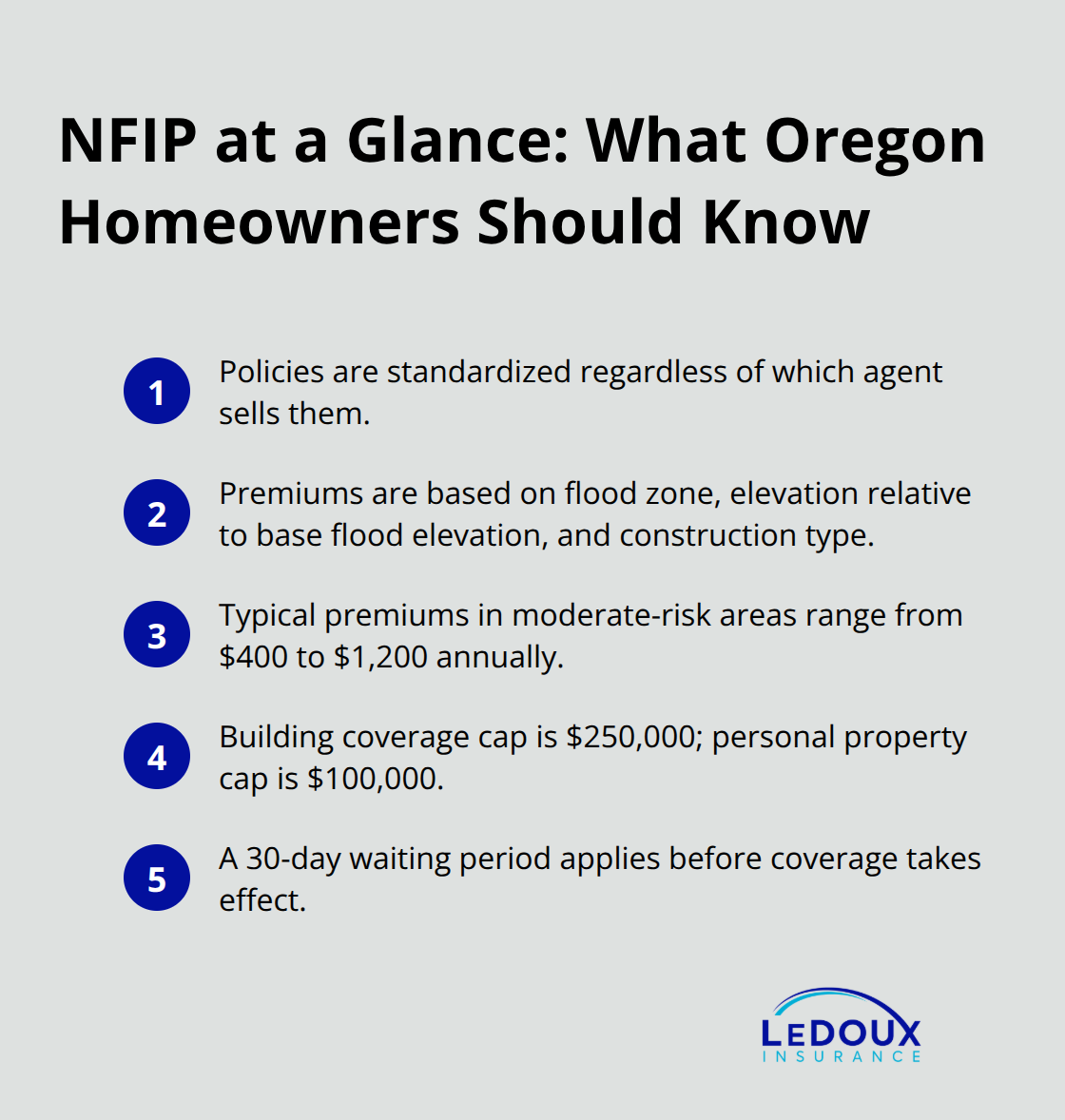
Additionally, NFIP policies include a 30-day waiting period before coverage takes effect, meaning you cannot purchase protection after a flood watch is issued.
Private Flood Insurance Offers Higher Limits and Flexibility
Private flood insurance has expanded substantially over the past five years as insurers recognize the market opportunity. These policies often provide higher coverage limits than NFIP, with some carriers offering up to $1 million in building coverage without the restrictive annual caps. Private carriers assess flood risk using detailed elevation data and sophisticated modeling, which sometimes results in lower premiums than NFIP for properties outside designated high-risk zones.
However, private policies vary considerably in what they cover, their deductible structures, and exclusions for certain water damage scenarios. You should compare NFIP and private options directly because the best choice depends on your specific property location, elevation, and coverage needs.
Layering Coverage Creates Comprehensive Protection
Some Oregon homeowners benefit from a layered approach where they purchase NFIP coverage as their base protection and supplement it with private insurance for additional limits. This combination strategy costs more upfront but delivers comprehensive protection that matches the actual replacement value of your home and belongings. The real question becomes not whether you can afford complete coverage, but whether you can afford to replace everything you own without it.
Choosing the Right Flood Insurance for Your Situation
Determine Your Property’s Actual Flood Risk
Start with determining your property’s actual flood risk, not what you assume it to be. The FEMA Flood Map Service Center provides free access to official flood zone designations, which directly affect your insurance costs and options. Properties in high-risk zones designated as Special Flood Hazard Areas pay substantially more for NFIP coverage, sometimes $2,000 or higher annually, while moderate-risk properties typically pay $400 to $1,200.
Official flood maps lag behind climate reality-properties outside designated zones still flood regularly in Oregon. Check whether your home sits near rivers, streams, or in areas prone to localized drainage issues through historical flood data from the Oregon Department of Geology and Mineral Industries and conversations with neighbors who have lived there longer than five years.
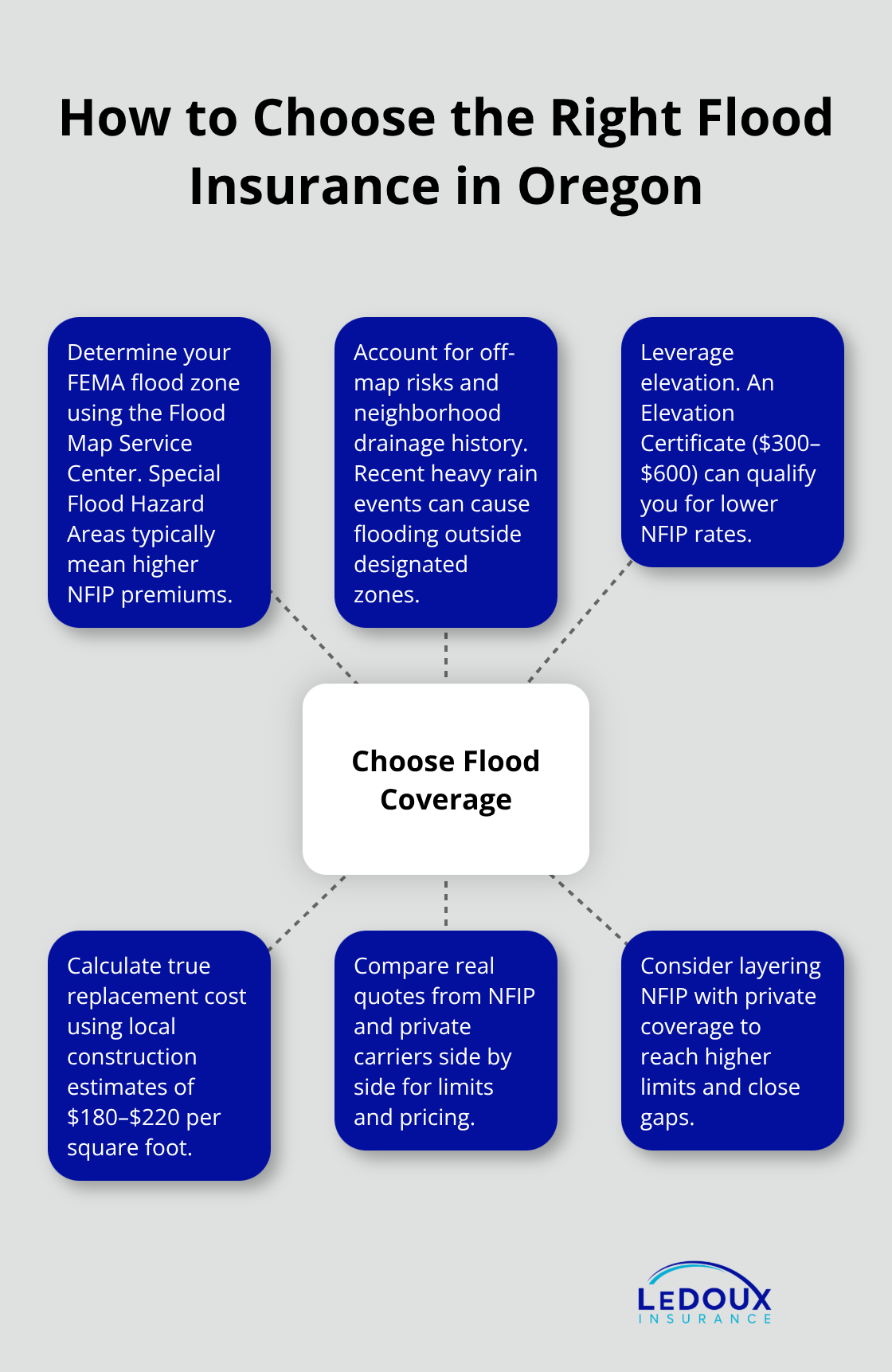
Elevation matters significantly; properties even slightly above the base flood elevation qualify for lower NFIP rates through the Elevation Certificate program, which costs $300 to $600 but can reduce your annual premium substantially.
Calculate Your True Replacement Value
Once you understand your risk level, compare specific coverage limits against your actual replacement costs. NFIP’s $250,000 building cap and $100,000 personal property cap leave most Oregon homeowners significantly underinsured-if your home would cost $400,000 to rebuild, that $250,000 covers only 62% of replacement costs. Private flood insurance eliminates these caps on many policies, offering limits up to $1 million or more.
Calculate your true replacement value through construction costs in your area. The National Association of Home Builders data shows costs range from $180 to $220 per square foot in Oregon, depending on location and quality. Your deductible choice directly impacts premiums; selecting a $5,000 deductible instead of $1,000 typically reduces annual costs by 15% to 25%, but only makes financial sense if you can absorb that expense after a flood.
Compare Real Quotes From Multiple Carriers
An independent agent who represents multiple carriers can run actual premium quotes for both NFIP and private options side by side. Comparing theoretical numbers produces misleading results-only real quotes show which option costs less for your specific property. This comparison reveals whether private coverage justifies its higher premium through better limits and flexibility, or whether NFIP remains your most cost-effective choice.
Final Thoughts
Flood insurance isn’t optional for Oregon homeowners-it’s the difference between recovering from a disaster and facing financial ruin. Standard homeowners policies won’t help you, and waiting until after a flood watch is issued means you’ve missed your opportunity. The reality is that flooding happens in Oregon regularly, and your property’s location doesn’t guarantee safety.
Oregon flood insurance options give you real choices that fit your budget and risk level. Whether you select the National Flood Insurance Program for its standardized coverage and accessibility, explore private policies for higher limits, or layer both approaches for comprehensive protection, solutions exist to match your actual exposure. The key is moving beyond assumptions about your flood risk and taking concrete steps to understand your true vulnerability.
Your next step is straightforward: assess your property’s flood risk, calculate your true replacement value, and compare actual quotes from multiple carriers. Contact LeDoux Insurance Agency Inc. to discuss your options and protect what matters most to your family.
The information provided in this blog is for general informational purposes only and does not constitute legal, financial, or insurance advice. Coverage options, terms, and availability may vary. Please consult with a licensed professional for advice specific to your situation. Artificial intelligence may have been used to generate text and images in some blog articles.

