

Auto Insurance Deductible Tips to Save on Every Claim
Your auto insurance deductible directly impacts how much you pay when you file a claim. Choosing the wrong amount can cost you thousands over time.
We at LeDoux Insurance want to help you understand auto insurance deductible tips that actually work. This guide shows you how to pick the right deductible, save money through smart strategies, and handle claims without breaking the bank.
What Your Deductible Actually Costs You
Your deductible is the amount you pay out of pocket before your insurance coverage kicks in. If you have a $500 deductible and cause $3,000 in damage, you pay $500 and your insurance covers the remaining $2,500. This straightforward concept shapes your entire financial relationship with auto insurance, yet most drivers pick deductibles based on guesswork rather than their actual situation.
How Deductibles Connect to Your Premium
The connection between deductibles and premiums is direct and measurable. Moving from a $500 to $1,000 deductible impact on annual premiums may reduce premiums by 10 to 20 percent, depending on your driving record and other factors. This means a $500 increase in out-of-pocket risk can save you a meaningful amount per year. The math works in your favor only if you can afford to pay that higher amount when a claim happens.
Most drivers carry deductibles between $500 and $1,000, with $500 being the most common choice across the United States according to insurance industry data. Some states see higher adoption of $1,000 deductibles in urban areas where collision risk is elevated, while rural drivers more often stick with $250 or $500 options.

The Real Cost of Low Deductibles
A $250 deductible feels safe, but it comes with a hidden price tag. You’ll pay more in premiums compared to someone with a $1,000 deductible. Over five years, that difference adds up to thousands of dollars you hand over whether you file a claim or not.
Most people file zero to one collision claim per decade, meaning low deductibles protect against an event that probably won’t happen while draining your wallet every month. High deductibles work only if you have emergency savings available. If you don’t have at least $1,000 to $2,000 in accessible funds, a high deductible becomes a liability trap that leaves you unable to pay when damage occurs.
Match Your Deductible to Your Financial Reality
Your deductible should match your emergency fund, not your wishful thinking. Calculate the maximum amount you can pay immediately without borrowing or credit card debt. That number is your ceiling. From there, try the highest deductible you can comfortably afford, then check the premium difference.
If moving from $750 to $1,000 saves $200 annually, that extra $250 in deductible risk often makes financial sense. If the savings are only $50 per year, the lower deductible might be worth the cost. Local insurance agents can help you work through these exact calculations with an understanding of your specific risk factors and driving patterns.
Now that you understand how deductibles impact your wallet, the next step involves choosing strategies that maximize your savings across your entire policy.
How to Stack Savings Across Your Auto Insurance
Bundling Policies Creates Immediate Savings
The most effective way to reduce what you pay on deductibles isn’t just picking the right amount-it’s combining that decision with other cost-cutting strategies that work together. When you bundle your auto policy with homeowners or renters coverage, insurers typically reduce your overall premium by 15 to 25 percent according to the National Association of Insurance Commissioners. This discount applies to all your policies, which means your auto premium drops significantly. The lower auto premium then makes a higher deductible even more attractive.
If your combined savings from bundling amount to $400 per year, moving from a $500 to $1,000 deductible suddenly feels manageable because the bundling discount absorbs much of the premium increase. Start by listing every insurance product you currently carry. Do you have homeowners insurance elsewhere? Renters coverage? Life insurance through your employer that you could consolidate? Each policy you bring under one roof creates negotiating power with your insurer.
Stacking Discounts Multiplies Your Savings
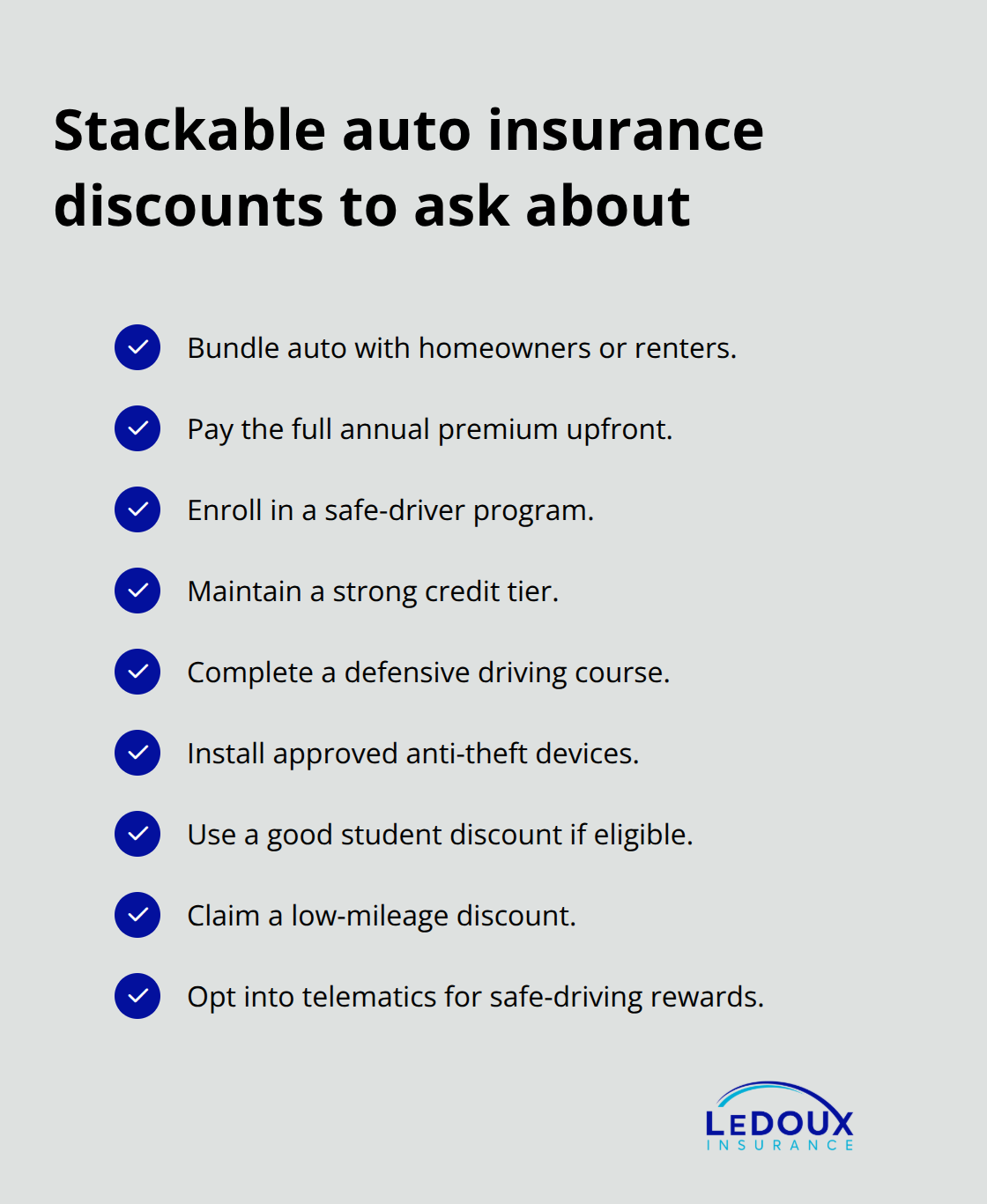
Beyond bundling, discounts for safe driving, paid-in-full premiums, and good credit scores lower your effective deductible cost without changing the actual amount you’d pay in a claim. The Insurance Information Institute reports that drivers who pay their annual premium upfront rather than monthly save an average of 5 to 10 percent. That’s $100 to $200 on a typical $1,500 annual premium. Safe driver discounts range from 10 to 30 percent depending on your state and insurer, which means three years without an accident or violation could save you $450 to $1,350 total.
These discounts compound with your deductible strategy. A driver with a clean record, bundled policies, and a $1,000 deductible pays far less than someone with a $500 deductible, no bundling, and no safety discounts. The math favors action over passivity.
Finding Discounts You’re Currently Missing
Contact your current insurer and ask specifically what discounts you’re missing. Many drivers qualify for discounts they never activate simply because they didn’t ask. Your insurer may offer discounts for completing defensive driving courses, installing anti-theft devices, or maintaining good grades if you’re a student. Some carriers reward low-mileage drivers or those who use telematics apps that monitor safe driving habits.
If your insurer can’t match competitor pricing after applying available discounts, that’s the moment to shop around. Local agents understand regional risk factors and carrier preferences that online quotes miss, making them invaluable when you’re restructuring your coverage to maximize savings. This foundation of bundled policies and stacked discounts sets the stage for the next critical decision: knowing when to file a claim and when to handle costs yourself.
Smart Claims Management to Protect Your Wallet
Calculate the True Cost of Filing a Claim
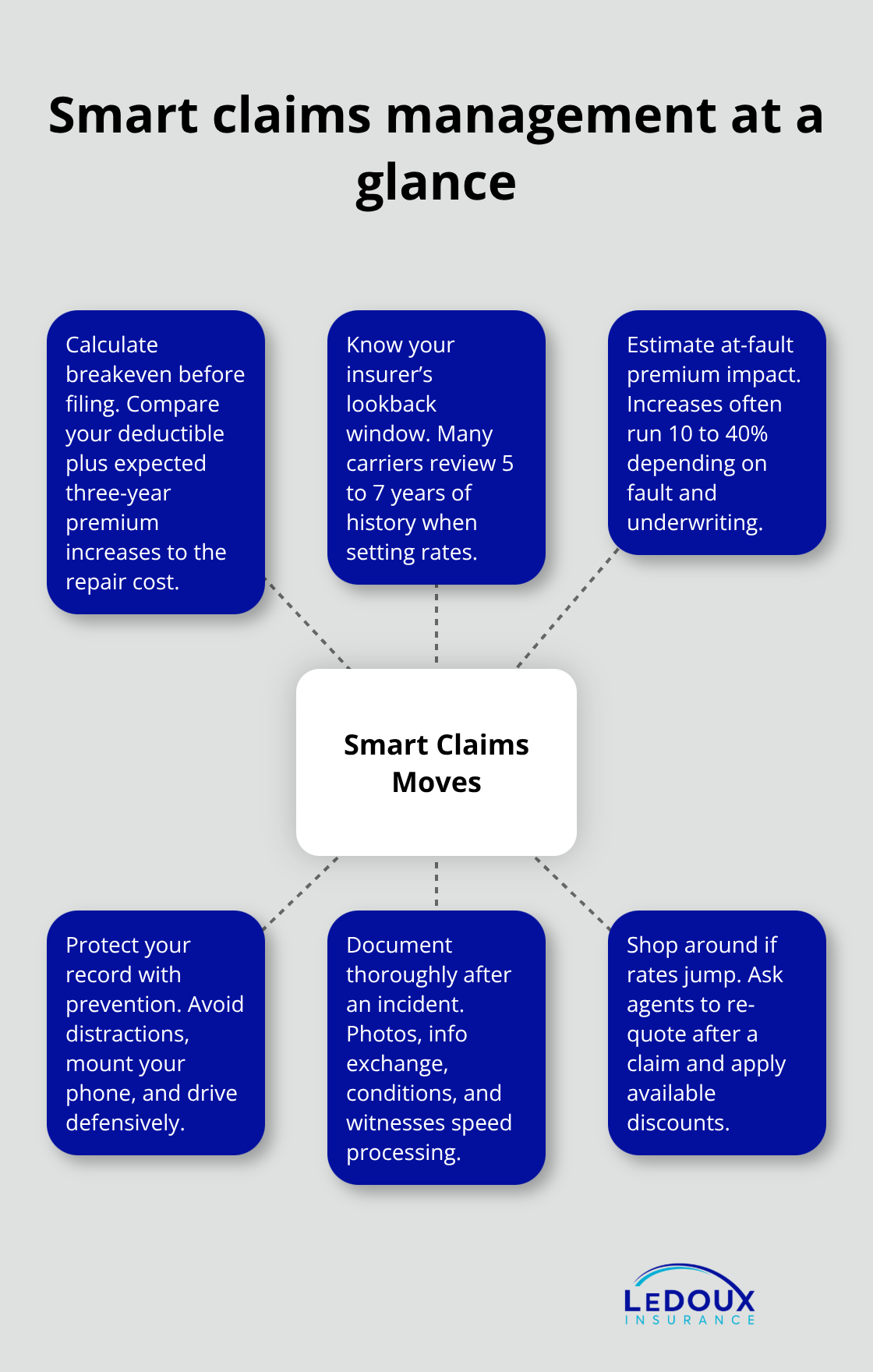
Filing a claim triggers consequences that extend far beyond the immediate payout. Your claims history follows you, and insurance companies in some states can look back 5 or even 7 years for rate setting. Even one claim can increase your premiums by 10 to 40 percent depending on fault status and your insurer’s underwriting practices, according to data from the National Association of Insurance Commissioners. This means a $3,000 claim that you file might cost you $1,500 more in premiums over the next three years, making it financially smarter to pay out of pocket.
The breakeven calculation is simple: if your deductible plus three years of premium increases exceeds the damage amount, you should pay the repair bill yourself. For example, if you cause $1,200 in damage with a $1,000 deductible, you already pay $1,000. If filing that claim raises your premium by $50 monthly for 36 months, you face an additional $1,800 in costs, totaling $2,800 when you could have paid $1,200 directly. This principle applies specifically to collision and comprehensive claims where you are at fault.
Liability claims work differently because the other party’s insurer pursues recovery, so filing liability claims carries different premium consequences. Contact your current insurer and ask for their specific premium increase percentages for at-fault claims in your state, then use that exact number to decide whether filing makes financial sense in your situation.
Protect Your Driving Record Through Prevention
Your driving record is your most valuable insurance asset, and every claim damages it regardless of the payout amount. Maintaining a clean record unlocks access to better rates when you shop for new coverage, while multiple claims lock you into higher-cost carriers with fewer options.
Preventing claims starts with eliminating distractions while driving. The National Highway Traffic Safety Administration reports that distracted driving causes 3,142 deaths annually, and drivers who use phones while operating vehicles are four times more likely to crash. Install your phone in a mount, silence notifications, and set your GPS before moving.
Aggressive driving behaviors including speeding, rapid lane changes, and tailgating correlate directly with collision frequency. Defensive driving courses reduce accident risk by 10 to 15 percent and often qualify for insurance discounts, making them free or low-cost investments in both safety and savings.
Document Everything Immediately After an Incident
When you do need to file a claim, documentation speed determines how quickly you receive payment and resolution. Photograph damage from multiple angles immediately after an incident, capture the other driver’s license and insurance information, note road conditions and weather, and collect contact information from any witnesses.
Insurance companies process claims faster when evidence is complete and organized, which means less time without your vehicle and faster closure to the incident. This foundation of smart claim decisions and thorough documentation protects both your wallet and your long-term insurance costs.
Final Thoughts
Your deductible should reflect your financial reality, not industry averages or what your neighbor carries. The auto insurance deductible tips covered throughout this guide transform deductible selection from a confusing checkbox into a strategic financial decision that balances protection with affordability. You now understand how deductibles connect to premiums, why bundling policies multiplies your savings, and when filing a claim actually costs more than paying out of pocket.
A local insurance agent gives you access to calculations and carrier options that online quote tools cannot provide. Agents understand your specific situation, your driving patterns, and the regional factors that influence your risk profile, then show you exact premium differences between deductible amounts and identify discounts you’re missing. These conversations take 20 minutes and often reveal hundreds of dollars in annual savings.
Gather your current policy documents and contact an agent to review your coverage, asking what discounts you’re currently missing, what your premium would change if you adjusted your deductible, and whether bundling additional policies makes financial sense for your household. Our team at LeDoux Insurance understands how to balance protection with affordability across Oregon, with access to more than 20 top-rated carriers and offices in Eugene, Salem, Woodburn, and Albany ready to help you implement these strategies today.
The information provided in this blog is for general informational purposes only and does not constitute legal, financial, or insurance advice. Coverage options, terms, and availability may vary. Please consult with a licensed professional for advice specific to your situation. Artificial intelligence may have been used to generate text and images in some blog articles.

