

Personal Umbrella Coverage Limits: How Much Protection Do You Need
One lawsuit or accident can wipe out years of financial progress. Your home and auto insurance policies have limits, and those limits might not be enough to protect everything you’ve built.
Personal umbrella coverage limits extend your protection far beyond what standard policies offer. At LeDoux Insurance Agency Inc., we help clients understand exactly how much coverage they need to safeguard their assets and future.
What Personal Umbrella Insurance Actually Covers
How Umbrella Coverage Works with Your Existing Policies
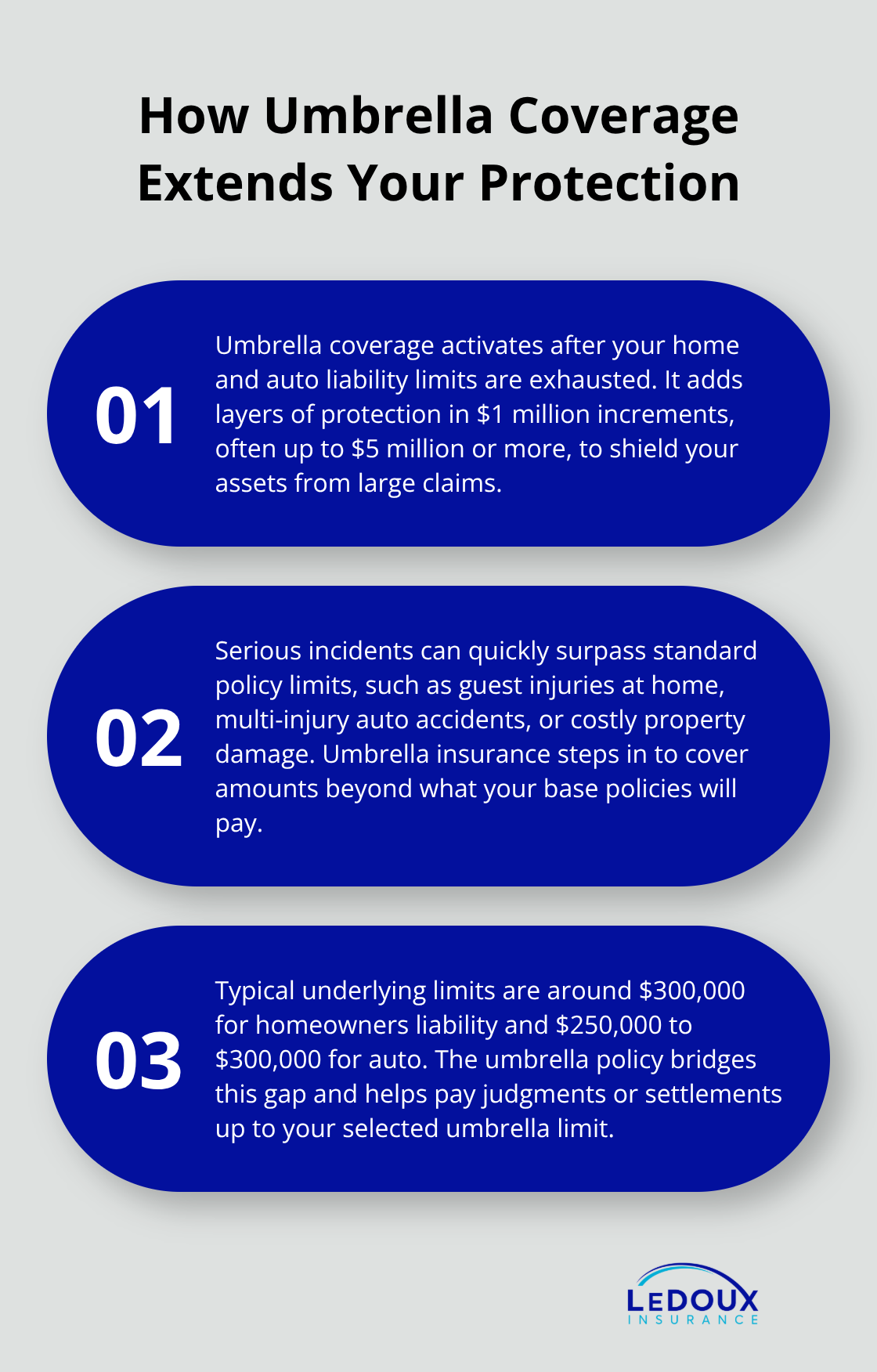
Personal umbrella insurance activates after your home and auto policies hit their limits, and it covers far more than most people realize. When someone sues you for injuries or property damage, your standard homeowners policy typically maxes out at $300,000 in liability, while auto policies often stop at $250,000 to $300,000. Umbrella policies fill that gap by providing additional layers of protection in $1 million increments, up to $5 million or more. A single serious accident-a guest injured at your home, a car crash where multiple people are hurt, or property damage from an incident on your property-can easily exceed those underlying limits. The umbrella doesn’t replace your home or auto coverage; it extends protection beyond what those policies will pay, covering the remainder of a judgment or settlement up to your umbrella limit.
What Your Umbrella Policy Actually Pays For
Umbrella policies cover bodily injury and property damage liability across multiple areas of your life, including incidents at your home, injuries caused by your vehicles, and even certain scenarios your primary policies might exclude or limit. According to NerdWallet, umbrella insurance also covers legal defense costs and court awards, meaning the policy pays for your attorney and any judgment against you once your underlying limits are exhausted. This includes personal injury claims like libel, slander, and false arrest that standard homeowners or auto policies often don’t cover at all. If you rent out property, umbrella coverage extends to landlord liability claims from tenants or guests, providing protection that a basic landlord policy might not fully address.
Risk Factors That Make Umbrella Coverage Essential
The Insurance Information Institute identifies specific risk factors that make umbrella coverage especially valuable: owning a swimming pool, hosting frequent gatherings, having a dog, or having a teenage driver in your household. A practical example from NerdWallet illustrates this clearly: if you cause a car accident with $500,000 in total injuries and your auto liability is $300,000, your umbrella policy covers the remaining $200,000. Most umbrella policies cost between $300 to $600 annually for $1 million of coverage, making this protection surprisingly affordable relative to the financial exposure you face without it.
Next Steps: Determining Your Coverage Needs
Understanding what umbrella insurance covers is only the first step. The real question becomes: how much protection do you actually need?
How Much Umbrella Coverage Do You Actually Need
Calculate Your Net Worth to Find Your Coverage Gap
Start with your net worth, not your gut feeling. Add up everything you own: your home equity, savings accounts, investment portfolios, vehicles, and retirement accounts outside of IRAs and 401(k)s, which federal law generally protects from lawsuits. According to Kiplinger, if your total assets exceed the maximum liability coverage of your auto and home policies combined, you should consider umbrella insurance. Most people carry about $250,000 to $300,000 in auto liability and $300,000 in home liability, which means a $550,000 combined ceiling. If your net worth exceeds that number, a gap exists. The math is straightforward: a $1 million umbrella policy typically costs $150 to $300 per year, while a $2 million policy averages around $380 annually according to Trusted Choice. Compare that to a single lawsuit where damages exceed your underlying limits, and the cost becomes irrelevant.
Assess Your Lifestyle and Activities
Your lifestyle and activities matter more than your income. Kiplinger identifies specific risk factors that dramatically increase your lawsuit exposure: owning a swimming pool, hosting frequent parties, renting out property, having a dog, coaching youth sports, or having a teenage driver. If you engage in any of these activities, your umbrella need shifts from optional to essential.

A teenage driver alone justifies a $1 million to $2 million policy given how often young drivers cause serious accidents. Landlords face particular exposure because tenant-related liability claims often exceed standard landlord policy limits, making umbrella coverage a practical necessity rather than a luxury.
Verify Your Underlying Policy Limits
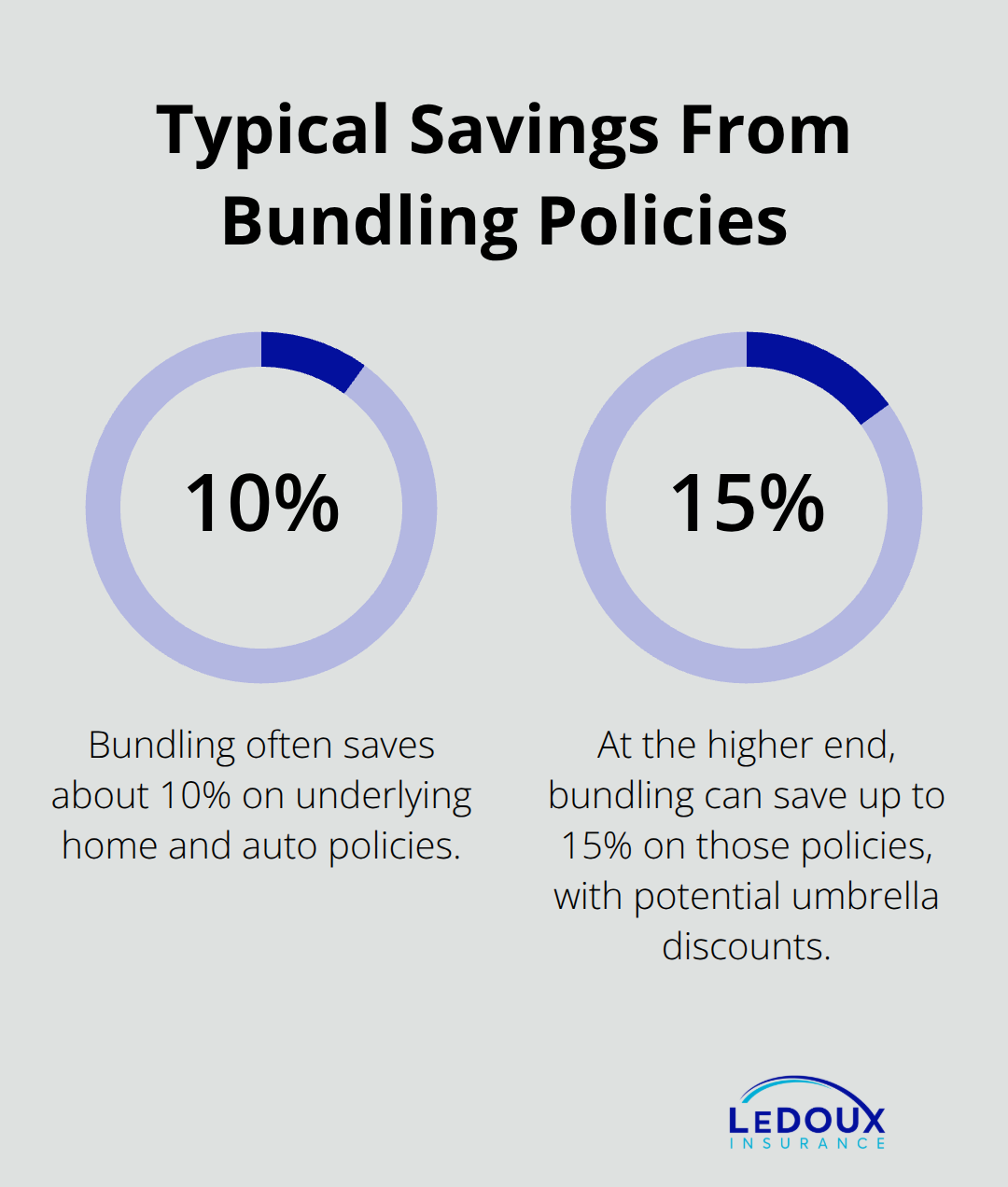
Most insurers require about $300,000 in auto liability and $300,000 in home liability before umbrella coverage activates. If your current limits fall short, raising them to the required minimums costs less than you might expect. Bundling umbrella with auto and home through the same insurer typically saves 10 to 15 percent on those underlying policies plus additional discounts on the umbrella itself, according to Kiplinger.
Most people start with a $1 million policy as a baseline because each additional $1 million increment costs progressively less than the first million. Once you understand your asset exposure and lifestyle risks, the next step involves selecting the specific coverage limit that aligns with your financial situation and protecting your assets accordingly.
Which Umbrella Limit Matches Your Financial Situation
The $1 Million Policy for Average Homeowners
A $1 million umbrella policy represents the practical starting point for most homeowners, and for good reason. According to Trusted Choice, $1 million of coverage typically costs $150 to $300 annually, making it the most affordable entry point into umbrella protection. This limit works well if your net worth falls between $500,000 and $1.5 million, your home is your primary asset, and your lifestyle carries moderate risk. You have a teenage driver but no pool, or you host occasional gatherings but don’t rent property. The math supports this choice: your home equity plus savings rarely exceed $1 million for the average American homeowner, so a $1 million umbrella caps your exposure at a level proportional to your actual assets.
However, a $1 million policy only makes sense if you’ve already maxed your underlying auto and home liability coverage. Many homeowners insurance policies provide a minimum of $100,000 in personal liability coverage. Anything less leaves gaps that the umbrella won’t cover, defeating the entire purpose of the protection.
The $2 Million to $5 Million Range for Higher Net Worth
Individuals with net worth between $1.5 million and $5 million need to move beyond the $1 million baseline. Kiplinger’s research shows that $2 million to $5 million policies provide appropriate coverage for this group. A $2 million umbrella typically costs around $380 per year according to Trusted Choice, while each additional $1 million increment costs progressively less. This tier includes people who own investment property, maintain significant investment portfolios, or operate side businesses.
A landlord with multiple rental properties faces substantially higher liability exposure than a homeowner with a single residence, making the jump to $2 million or $3 million essential rather than optional. The same applies to anyone with a net worth that includes substantial liquid investments or multiple properties.
Coverage for Business Owners and High-Risk Occupations
Business owners and high-net-worth individuals with complex asset structures often carry $5 million to $10 million in umbrella coverage, though this segment represents a smaller percentage of the population. These individuals typically own commercial real estate, operate businesses, or maintain assets exceeding $5 million. They view umbrella insurance as a fundamental component of asset protection strategy rather than an optional add-on.
Final Thoughts
The right personal umbrella coverage limits protect your financial future by filling the gap between what your home and auto policies cover and what a serious lawsuit could cost. Without this protection, a single accident or injury claim forces you to liquidate savings, investments, or home equity to pay damages that exceed your underlying policy limits. Umbrella insurance remains one of the most affordable ways to prevent financial disaster, with $1 million policies starting around $150 to $300 annually.
Your coverage needs shift over time as your assets grow, your family changes, or your lifestyle evolves. A $1 million policy that made sense five years ago may fall short today if you’ve purchased investment property, accumulated significant savings, or added a teenage driver to your household. Life changes like marriage, home purchases, rental property acquisitions, or major career shifts all warrant a fresh look at whether your current umbrella limit still matches your actual exposure.
We at LeDoux Insurance Agency Inc. help Oregon families and business owners across Eugene, Salem, Woodburn, and Albany determine the right umbrella protection for their specific situation. With access to 20+ top-rated carriers, we can show you how bundling umbrella with your auto and home policies typically saves 10 to 15 percent on those underlying policies while providing the additional protection you need. Contact us today to discuss your personal umbrella coverage limits and find the protection that matches your assets.
The information provided in this blog is for general informational purposes only and does not constitute legal, financial, or insurance advice. Coverage options, terms, and availability may vary. Please consult with a licensed professional for advice specific to your situation. Artificial intelligence may have been used to generate text and images in some blog articles.

