

Umbrella Liability Insurance Tips: How to Build Strong Personal Protection
Your standard homeowners and auto insurance policies have limits. Once you exceed those boundaries, your personal assets face real financial risk.
At LeDoux Insurance Agency Inc., we help clients understand umbrella liability insurance tips that protect what they’ve worked hard to build. This guide walks you through coverage options, when you need protection, and how to choose the right policy for your situation.
How Umbrella Insurance Fills the Gap
What Umbrella Coverage Actually Does
Standard homeowners and auto policies come with liability limits that sound protective until you face a serious incident. Most homeowners policies cap personal liability at $300,000 to $500,000, while typical auto policies max out at $500,000 for bodily injury liability per accident. These limits worked fine decades ago, but they don’t match today’s reality. A single car accident causing severe injuries can easily exceed $750,000 in damages. A lawsuit from a dog bite, a guest injured on your property, or a defamation claim can drain your savings fast. Umbrella liability insurance sits on top of your existing policies and activates when those underlying limits get exhausted. It covers bodily injury to others, property damage you cause, and personal injury claims like libel or slander. Unlike your homeowners or auto policy, an umbrella policy doesn’t replace your underlying coverage-it extends protection beyond what those policies provide.
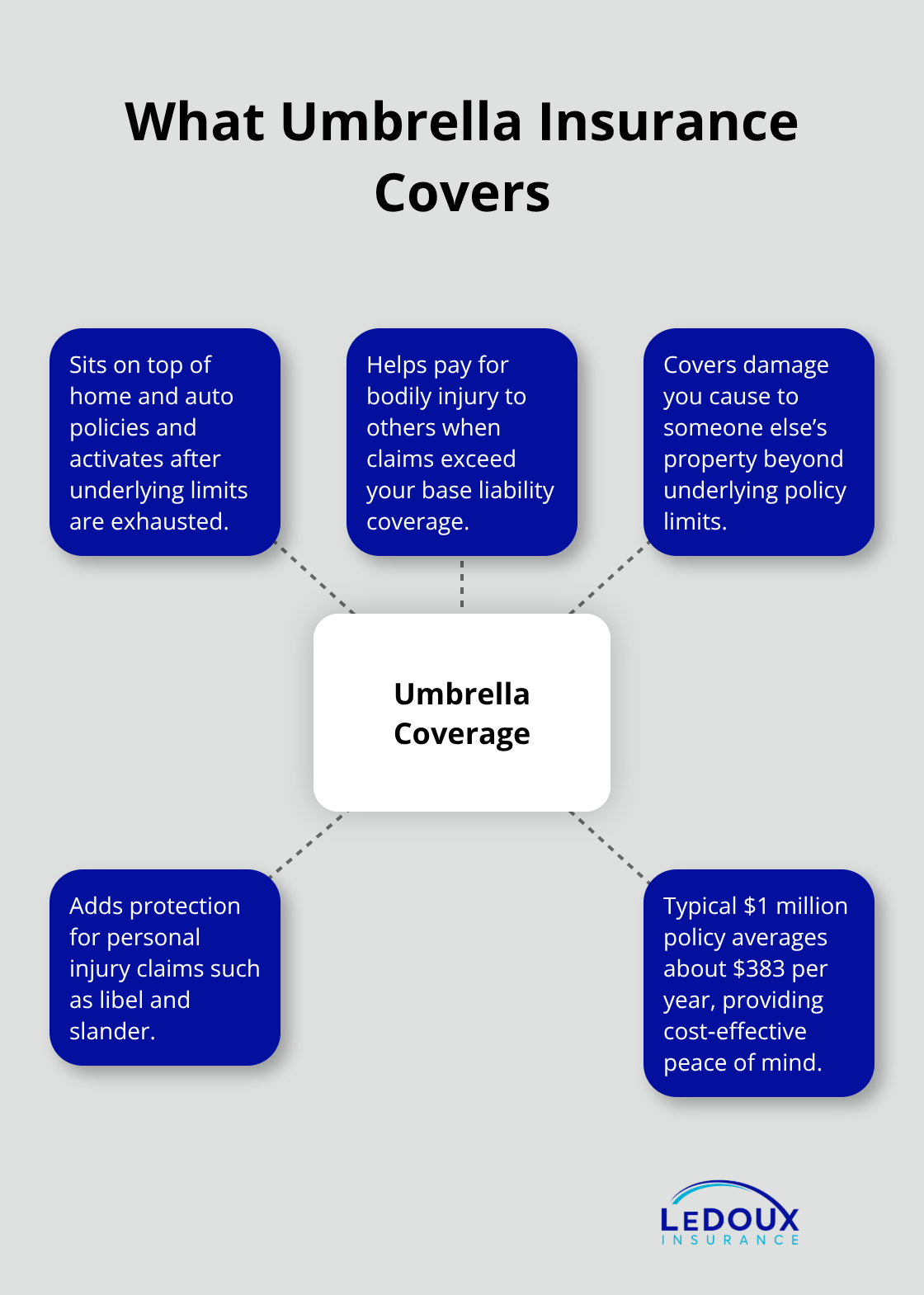
In Oregon, the average cost for $1 million in umbrella coverage runs about $383 per year for a typical household with one home and two cars. That modest premium buys significant peace of mind when your assets are on the line.
Why Your Current Limits Fall Short
A $500,000 liability limit sounds substantial until you calculate what serious injuries actually cost. Medical treatment for catastrophic injuries, lost wages, pain and suffering damages, and legal fees add up quickly. In a multi-vehicle accident where you’re at fault, medical bills alone can reach $1 million. Your auto policy covers the first $500,000, but you remain personally liable for the remaining $500,000 and any additional damages awarded. An umbrella policy would cover that gap. The same exposure exists with homeowners liability. A guest falls down your stairs, suffers permanent disability, and sues for $750,000 in damages. Your homeowners policy pays $300,000, leaving you to cover $450,000 from personal assets. Renters with significant savings face identical risk. If you own rental property, tenant liability claims add another layer of exposure that standard coverage doesn’t adequately address. Umbrella coverage extends to landlord liability, protecting you against claims from tenants or visitors on rental properties.
Calculating Your Coverage Amount
The right umbrella limit depends on your total assets and future earning potential. Add up your home equity, savings, investments, and vehicles. This total represents what creditors can pursue if you lose a major lawsuit. If your assets total $1.5 million but your underlying liability limits cap at $500,000, a $1 million umbrella policy leaves a $500,000 gap. Most carriers offer coverage in $1 million increments, with Money.com reporting that each additional $1 million of coverage typically costs about $75 per year. That pricing means moving from $1 million to $2 million in umbrella protection costs roughly $458 annually instead of $383. Higher net worth individuals often carry $2 million to $5 million in umbrella coverage. Your umbrella limit should exceed your total assets. Federal protections exist for certain retirement accounts (401(k)s receive protection under ERISA according to the U.S. Department of Labor), but IRAs vary by state. An independent agent who understands your specific situation can help you calculate the appropriate coverage level and identify any gaps in your current protection strategy.
Who Actually Needs Umbrella Protection
Assets Worth Protecting
Most people assume umbrella insurance is only for the wealthy, but that’s wrong. You need umbrella coverage if you own meaningful assets, host people at your home, drive regularly, or face any situation where someone could sue you for serious injuries or damages. The threshold isn’t about net worth-it’s about exposure. A homeowner with $400,000 in equity, $150,000 in savings, and a $50,000 vehicle has $600,000 in assets worth protecting. A single liability claim exceeding your underlying policy limits puts all of that at risk.
High-Risk Situations That Increase Your Exposure
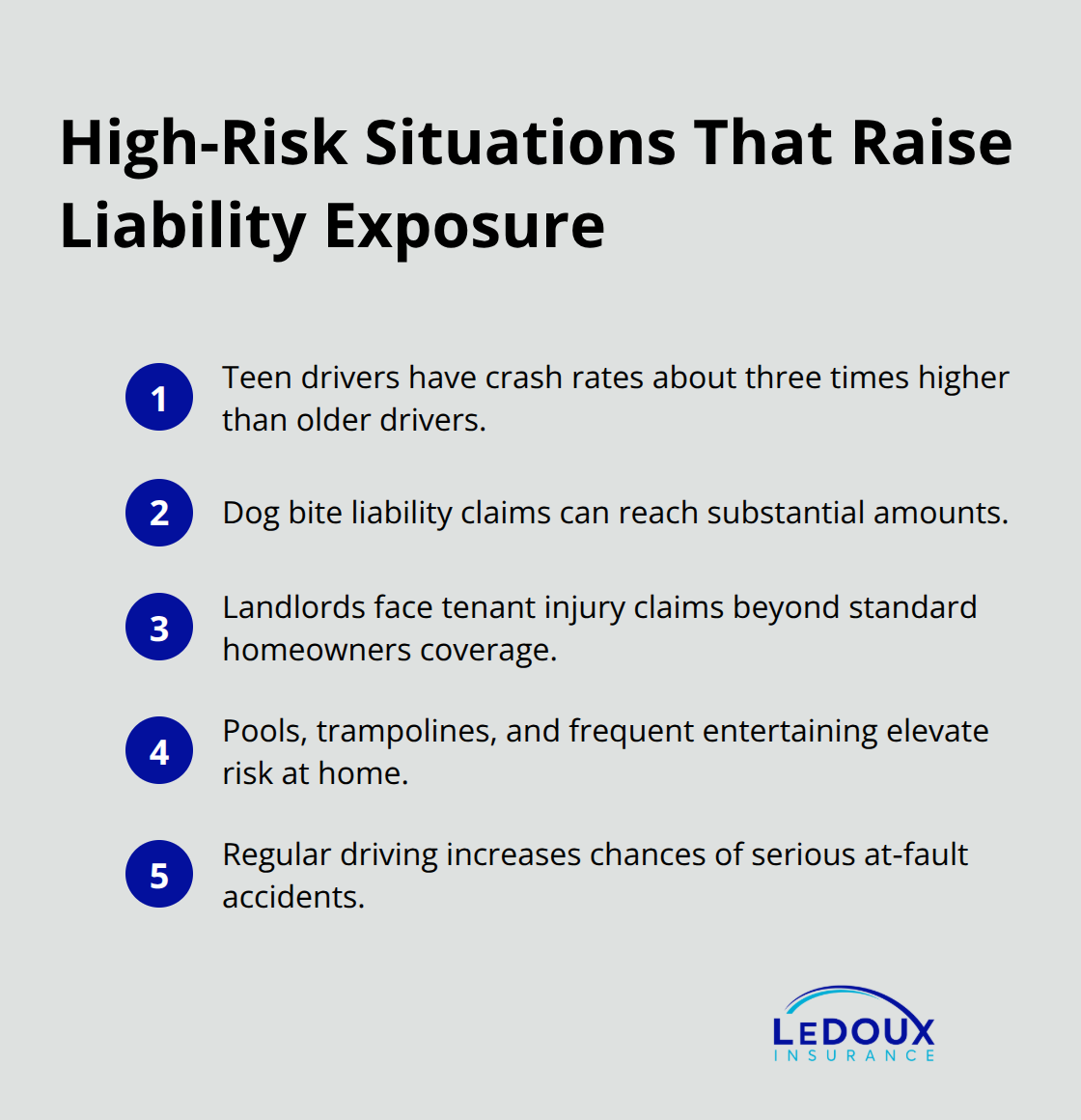
Dog owners face particular exposure because liability claims from bites can reach substantial amounts. If your homeowners policy covers $300,000 in personal liability and a guest’s dog bite claim reaches $500,000, you’re personally responsible for the $200,000 gap. Pool owners, trampoline owners, and anyone who entertains guests regularly carry elevated risk. Landlords absolutely need umbrella coverage because tenant liability claims from injuries on rental property fall outside standard homeowners protection. A tenant injured in a common area suing for $600,000 in damages can access your personal assets if your landlord liability limits are insufficient.
Teen drivers in your household significantly increase exposure. According to industry data, drivers under 20 have crash rates three times higher than drivers aged 20 and older. Even a single accident involving a teen driver could generate claims well beyond typical auto policy limits. Umbrella coverage activates after your underlying auto policy maxes out, protecting your family’s financial security.
Calculating Your Actual Gap
The practical approach is calculating what you actually stand to lose. Add your home equity, liquid savings, investment accounts, and vehicle values. If that total exceeds your current liability limits by more than $250,000, umbrella insurance becomes financially sensible rather than optional. Someone with $800,000 in assets and $500,000 in combined auto and homeowners liability limits has a $300,000 gap that a $1 million umbrella policy closes affordably.
The cost difference between $1 million and $2 million in umbrella coverage is roughly $75 annually, making it inexpensive to match your protection to your actual exposure. Retirees with substantial savings should prioritize umbrella coverage because they have limited ability to recover from major liability judgments through future earnings. A $750,000 lawsuit against a retiree with $1 million in savings can be catastrophic.
Special Circumstances That Matter
Umbrella policies typically apply worldwide, which matters if you travel internationally or maintain property abroad. If you expect your income and assets to grow significantly over the next five years, purchasing umbrella coverage now locks in lower premiums and ensures protection during your accumulation phase. Your specific situation-whether you own rental properties, host frequent gatherings, or have multiple vehicles-determines how much umbrella protection makes sense for your household.
Selecting the Right Umbrella Coverage for Your Situation
Identify Your Coverage Gaps
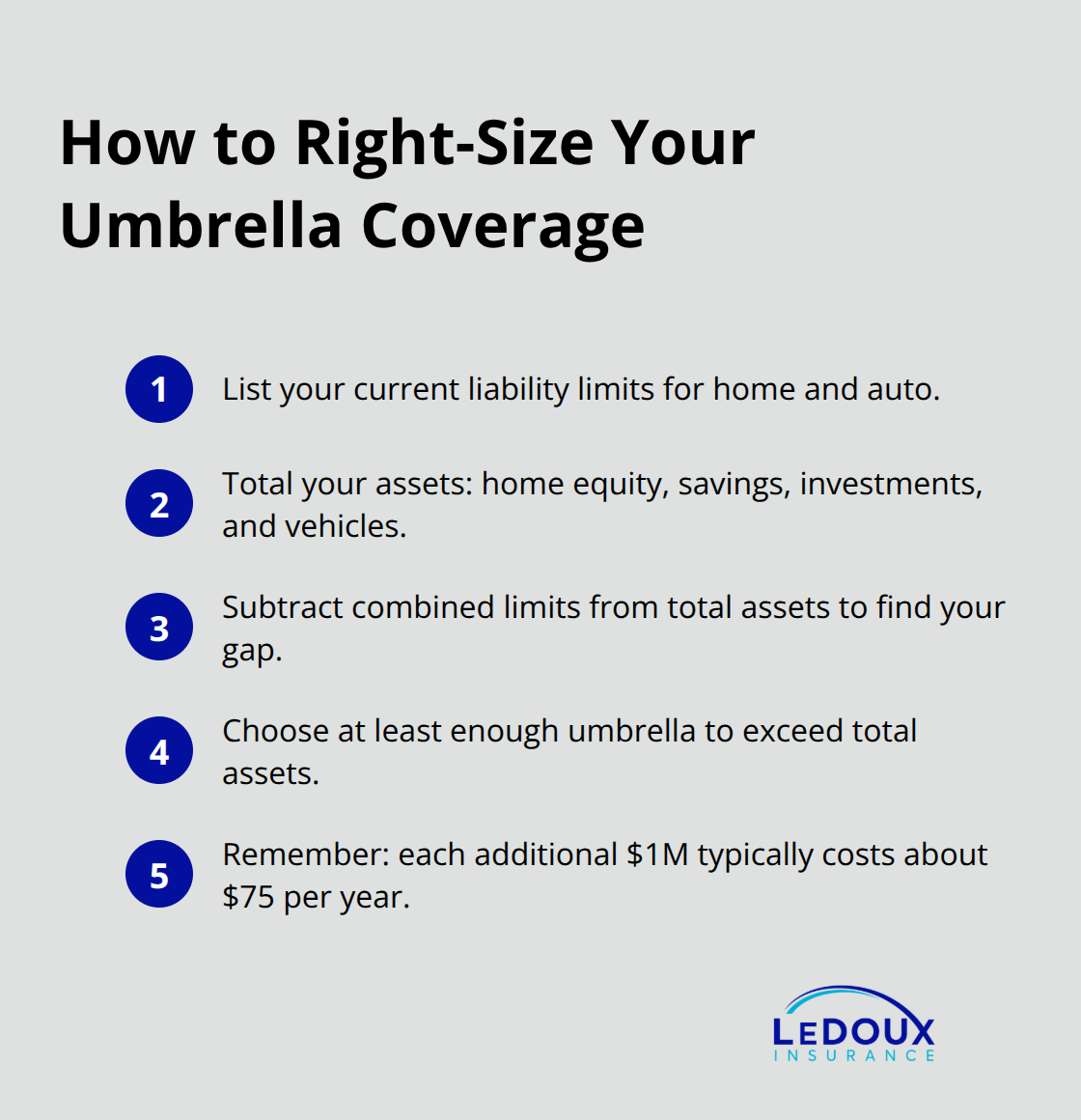
Start by identifying exactly what your current policies won’t cover. Pull out your homeowners and auto policy declarations pages and write down your liability limits for bodily injury, property damage, and personal liability. Most people discover their limits are lower than they assumed. If you carry $300,000 in homeowners liability and $500,000 in auto bodily injury liability, your total protection across both policies is fragmented-a $750,000 claim leaves you exposed. Calculate this gap by subtracting your combined limits from your total assets. That number is what umbrella insurance must cover.
Someone with $1.2 million in home equity, savings, and investments facing $800,000 in existing liability limits needs at least $400,000 in umbrella protection, though most carriers sell in $1 million increments starting at roughly $383 annually according to ACE Private Risk Services data. The actual cost difference between a $1 million policy and a $2 million policy runs about $75 per year, making it inexpensive to purchase more protection than your minimum gap suggests. This approach replaces guesswork with concrete math.
Compare Policies and Underwriting Requirements
Comparing actual policies requires understanding what different carriers exclude and how their underwriting requirements differ. Some insurers require minimum underlying liability limits before selling umbrella coverage-GEICO typically requires $300,000 per person bodily injury on auto policies, while others are more flexible. Call three to five carriers directly and ask about their specific requirements, exclusions for dog breeds or high-risk activities, and whether they offer discounts for bundling with your homeowners or auto policy.
An independent agent representing multiple carriers gives you access to options you won’t find shopping with a single company. LeDoux Insurance Agency Inc. represents 20+ top-rated carriers, which means we match your specific situation to the right policy rather than forcing you into one company’s template. Ask each agent whether the umbrella policy covers international travel, rental property liability, and how it interacts with your underlying policies if you later increase those limits.
Evaluate Hidden Costs and Policy Interactions
Some carriers penalize you for raising auto or homeowners liability limits by increasing umbrella premiums, while others don’t. These details matter far more than shopping purely on price. Request quotes in writing and compare the actual coverage language, not just the premium. Your situation is unique enough that the cheapest option often carries hidden gaps that cost far more later.
Final Thoughts
Umbrella liability insurance tips ultimately protect what you’ve built through years of hard work and smart financial decisions. A single serious incident can wipe out your home equity, savings, and investments if your liability limits fall short, but umbrella coverage costs roughly $383 annually for $1 million in protection. That modest premium shields hundreds of thousands of dollars in personal assets from creditors and lawsuits.
Your next step is straightforward: pull your homeowners and auto policy declarations and calculate your actual gap. Add your home equity, savings, and investments, then subtract your combined liability limits-that number tells you exactly how much umbrella protection you need. Most people discover their gap is larger than they expected, which is why this exercise matters far more than generic online quotes.
We at LeDoux Insurance Agency Inc. help Oregon families and business owners across Eugene, Salem, Woodburn, and Albany build comprehensive protection strategies that match their specific situation. Contact us for a straightforward conversation about your assets, your current coverage, and the umbrella protection that makes sense for your household.
The information provided in this blog is for general informational purposes only and does not constitute legal, financial, or insurance advice. Coverage options, terms, and availability may vary. Please consult with a licensed professional for advice specific to your situation. Artificial intelligence may have been used to generate text and images in some blog articles.

